Key takeaways
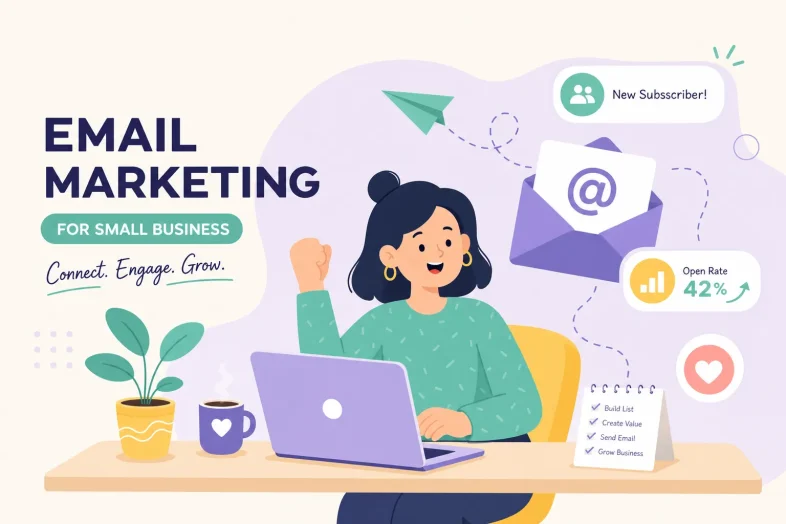
- Email marketing is one of the most affordable and effective ways for small businesses to stay connected with customers and drive repeat sales.
- You own your email list. No algorithm can take it away the way social platforms can.
- Many beginners can set up a basic sign-up form and send a test email within a few hours, even with no technical background.
- The most effective small business email campaigns are welcome sequences, newsletters, and promotional offers.
- Click-through rate is your most reliable performance signal in 2026, since open rates have become less accurate due to Apple's Mail Privacy Protection. Unsubscribe rate and CTR together give you a clearer read on what's working.
- Working With Walter publishes small-business-focused platform reviews to help you compare beginner-friendly ESP options before you commit to one.
Email marketing delivers roughly $36 to $42 for every $1 spent, making it the highest-ROI digital channel available to small business owners. That figure comes from research published by the Data & Marketing Association (DMA) and has been corroborated by Litmus and HubSpot across multiple annual reports. And yet many small business owners either haven't started an email list or abandoned one because they weren't sure what to do with it.
This guide fixes that. You'll learn what email marketing actually is, how to build a list from scratch, which types of emails to send, how to pick a platform, and how to read the numbers that matter. No technical background required.
What email marketing actually is and why it still works
Email marketing is the practice of sending targeted messages to a list of people who gave you their contact information and agreed to hear from you. That permission piece is what separates a well-run email program from spam. You're not blasting strangers; you're communicating with people who raised their hand and said they want to stay in touch with your business.
Social media reach is controlled by algorithms that shift without warning. An email lands directly in a subscriber's inbox, no algorithm gatekeeping required. Industry open rates in 2026 range from roughly 21% to 39% depending on your sector, according to benchmark data from ActiveCampaign and Campaign Monitor. That kind of direct access is worth protecting.
Why small business owners need an email list right now
Your social media followers aren't yours. Neither is your Google search traffic. Both can disappear overnight when a platform changes its rules. An email list is a business asset you own and control completely. For example, it's common for local service businesses to spend years building a social following, only to see organic reach drop to near zero after an algorithm update. Compare that to a list of 500 engaged email subscribers who consistently open, click, and respond.
Email also drives repeat business, which is where most small business profit actually lives. A customer who bought from you once already trusts you. A well-timed email brings them back for a second or third purchase without spending a dollar on new customer acquisition. Re-engagement campaigns and regular newsletters keep you top-of-mind between purchases, turning one-time buyers into loyal customers.
How to build your email list from scratch
Start with placement. Put your sign-up form on your website homepage, your contact page, and your checkout flow if you sell products online. For brick-and-mortar or service businesses, a tablet at the counter or a simple paper sign-up sheet works just as well. Many small businesses get a basic pop-up or embedded form connected to a free ESP live within a few hours, though setup time will vary by platform and any integrations you need.
Quality beats quantity every time. Two hundred subscribers who genuinely opted in are worth more than 2,000 names from a purchased list. Purchasing lists is strongly discouraged: it increases compliance risk, damages your deliverability, and violates best-practice guidance from every major ESP. (For a deeper comparison of paid traffic and list-building approaches, see Solo Ads vs. Other Email Marketing Strategies, Working With Walter.) The FTC's CAN-SPAM guidance reinforces the importance of genuine consent and proper opt-out handling, so build your list with real permission from day one.
Most people won't subscribe for nothing, so offer something in return. The best lead magnets for small service businesses are direct and immediately useful:
- A discount or first-purchase offer
- A free checklist, guide, or cheat sheet relevant to your service
- A free consultation or audit
- Access to a short tutorial or video training
The offer should connect directly to what you sell. That way, the people who subscribe are already interested in your services, not just hunting for a free download. Affiliate marketers may find targeted guidance helpful, see Email Marketing Strategy For Affiliate Marketing Beginners With Opt In Leads, Cliqly, Working With Walter.
The types of emails every small business should send
A welcome sequence is your highest-leverage asset. It's a short automated series of 3 to 5 emails that fires immediately after someone subscribes. The first email delivers whatever you promised (the lead magnet or discount). The second introduces your business and sets expectations. The third shares social proof: a testimonial, a case study, or a specific result you've delivered. Welcome emails consistently earn 20% to 30% click-to-open rates, the highest of any email type, so spend real time crafting them.
Beyond the welcome sequence, three other email types belong in every small business toolkit. A regular newsletter (weekly or monthly) keeps your audience informed and builds the relationship over time. Promotional emails cover sales, seasonal offers, and new service launches. Re-engagement campaigns target subscribers who have gone quiet with a direct “we miss you” message and a reason to come back.
Once those basics are solid, drip campaigns, automated sequences triggered by specific subscriber actions, are a natural next step. They let your program grow without adding more manual work on your end.
Email marketing deliverability best practices
Getting your emails into the inbox matters as much as what's inside them. Deliverability depends on your sender reputation and a few technical settings your ESP can help you configure. The three most important authentication standards are SPF (Sender Policy Framework), DKIM (DomainKeys Identified Mail), and DMARC (Domain-based Message Authentication, Reporting & Conformance). Most beginner-friendly ESPs walk you through these during setup, but it's worth confirming they're active before you start sending at scale.
Beyond authentication, keep your list clean by removing hard bounces promptly and re-engaging or removing inactive subscribers every few months. Sending to a smaller, engaged list consistently outperforms blasting a large, stale one.
How to choose the right email platform for your business
For a first-time ESP, focus on five things: ease of use, automation features, list segmentation, deliverability reputation, and pricing at the free or entry-level tier. Most beginners do well on a free plan that supports up to 500 to 1,000 contacts and includes basic automation, enough to run a welcome sequence, a monthly newsletter, and a simple promotional campaign. Free-plan limits vary by provider; Mailchimp, Zoho Campaigns, and Kit (formerly ConvertKit) each structure their tiers differently, so compare before you sign up.
One platform's drag-and-drop builder might feel intuitive to you and clunky to someone else. Pricing also changes once your list grows past the free tier threshold, so it's worth understanding the cost curve before you commit.
Rather than signing up for five free trials to figure out what fits, check the platform comparisons and tool reviews at Working With Walter. The reviews are written for non-technical small business owners, not enterprise marketing teams. You'll get straightforward guidance on which ESPs work best depending on your list size, budget, and goals. For a broader view of what to look for when choosing an ESP, see this guide on what to look for when choosing an email service provider.

Simple metrics that tell you if your email marketing is working
Start by tracking three numbers: open rate, click-through rate (CTR), and unsubscribe rate. Open rate shows how many people opened your email. CTR shows how many clicked something inside it. Unsubscribe rate shows whether you're losing subscribers faster than you should be.
The 2026 benchmarks give you a clear baseline. Industry average open rates run from 21% to 39% depending on your sector. The all-industry average CTR sits around 2.6%. A healthy unsubscribe rate stays below 0.5%. One important note: Apple's Mail Privacy Protection has made open rates less reliable as a standalone metric, so CTR is now your cleaner performance signal. If people are clicking, the email is working. For additional benchmark breakdowns by channel and industry, see Klaviyo's email marketing benchmarks.
When your numbers fall below average, the fix is usually straightforward. A low open rate points to weak subject lines or the wrong sending time. A low CTR suggests the content or offer isn't matching what your subscribers want. A high unsubscribe rate often means your emails arrive too frequently or feel irrelevant. Change one variable at a time, subject line, send day, or offer, and compare results. Testing doesn't have to be complicated to be effective. For help writing better subject lines, check these subject-line formulas from Campaign Monitor.
Boost your online visibility beyond email
Email marketing is powerful, but it works best when paired with a strong overall online presence. If you'd rather have a professional handle your digital visibility setup while you focus on running your business, visit agencyservicesgrp.com to see what's available across search, social, and email. It's a useful next step for any small business owner ready to grow beyond the basics.
Frequently asked questions about email marketing for small businesses
How often should a small business send marketing emails?
Start with once or twice a month and adjust based on your engagement data. Consistency matters more than frequency. A monthly email your subscribers look forward to beats a weekly one they ignore, and eventually unsubscribe from. Most email marketing research suggests this cadence works well for beginners, but the right frequency ultimately depends on your industry and how much value you can deliver per send.
Do I need a website to start an email list?
No. Most ESPs let you create a hosted sign-up landing page directly within the platform. A link to that page in your social media bio is all you need to start collecting subscribers today.
What's the difference between an email newsletter and an email campaign?
A newsletter is a recurring, relationship-building email sent on a regular schedule. A campaign is a targeted message sent with a specific goal, like promoting a sale, announcing a new service, or re-engaging inactive subscribers.
Is email marketing legal, and what do I need to do to comply?
Yes, but you must follow CAN-SPAM rules in the US. Every email needs your physical business address, a working unsubscribe link, and a non-deceptive subject line. Honor opt-out requests promptly, the law requires you do so within 10 business days, and avoid purchasing or renting email lists, which creates significant compliance and deliverability risk.
How do I know which email platform is right for my business?
Start with your budget and your current subscriber count. Most beginners do fine on a free plan. For side-by-side comparisons written for small business owners rather than corporate marketing teams, check the platform reviews at Working With Walter before you commit to anything.
Start where you are and build from there
Email marketing is one of the most cost-effective tools a small business owner has, and getting started is far simpler than most people expect. You don't need a big list or a big budget, and a technical background isn't required. You need a clear offer, a basic sign-up form, and a platform that lets you send consistent, useful messages to people who asked to hear from you.
The core progression is straightforward: understand what email marketing is, build a list the right way, send the right types of emails, choose a platform that fits your workflow, and track a few key numbers. That's the whole system at the beginner level.
Pick one step from this guide and execute it this week. You could sign up for a free ESP account, or add a sign-up form to your website, either move puts you ahead of the majority of small businesses still waiting for the “perfect moment” to start. When you're ready to go deeper, Working With Walter has tool reviews, strategy guides, and resources to support you at every stage of the journey. For a roundup of industry stats and trends you can reference as you plan, see HubSpot's email marketing statistics.