Key takeaways, how to build an email list from scratch
- Pick a free email service provider (ESP) first; you need it before anything else works.
- Create a lead magnet that solves one specific problem, “subscribe to my newsletter” is not a lead magnet.
- You do not need a website or a paid tool to get started; free landing page builders give you a shareable URL immediately.
- Interactive quizzes and calculators convert at 30, 50%; niche-specific checklists and templates convert at 5, 17%.
- CAN-SPAM requires an unsubscribe link in every commercial email; GDPR requires explicit opt-in if you target EU residents.
- Reaching 1,000 subscribers in 6, 12 months is realistic for most beginners; favorable conditions like an existing audience or strong traffic sources can shorten that timeline.
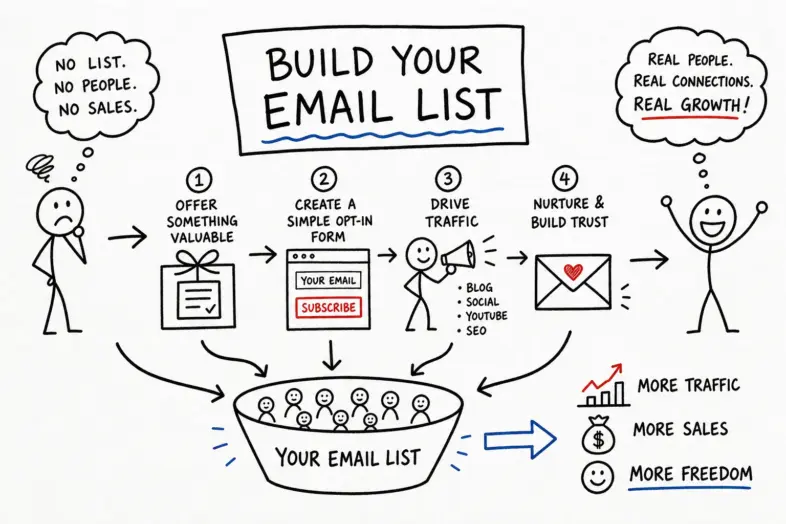
If you want to know how to build an email list from scratch, start here: you don’t need a website, a big budget, or a technical background. What you actually need is a place to collect addresses, a reason for people to give you theirs, and a consistent habit of showing up. That’s it.
Here’s what makes email different from every other marketing channel: you own it. Social media followings are vulnerable to algorithm shifts, an Instagram account that reaches thousands today can lose most of that reach overnight. Your email list, by contrast, belongs to you. No platform can take it away. That kind of stability is worth building toward, especially if you’re starting from zero.
The beginner resources at Working With Walter were built specifically for people who don’t have a technical background and need step-by-step help that doesn’t assume prior knowledge. This guide follows that same philosophy: five clear steps, no fluff, and a realistic path to your first 1,000 subscribers.
Step 1. Choose a free email platform before you do anything else
Your ESP is the foundation. Without one, you have nowhere to collect addresses and no way to send emails at scale. The good news is that free tiers on the best email service providers are more than enough to carry you through your first 500 to 1,000 subscribers. For a non-technical walkthrough on using simple platforms to send proven emails from home, see How A Turnkey Email Platform Makes Sending Proven Emails From Home Simple, Working With Walter.
Which free ESPs work best for beginners
MailerLite gives you 1,000 subscribers free, with a built-in landing page builder and basic automation included. Brevo lets you store up to 100,000 contacts at no cost, though you’re capped at 300 emails per day. Sender offers 2,500 subscribers free with unlimited automation workflows, one of the most generous free plans available in 2026. All three include drag-and-drop builders and pre-built automation sequences.
What to check before you commit to a platform
First, confirm that automation is available on the free plan. Some platforms lock sequences behind a paid tier, which limits you early. Second, look for a built-in landing page builder, this is critical if you don’t have a website yet, because you need a shareable opt-in URL from day one. Third, check how easy it is to embed a signup form on an external page. These factors determine whether a free plan will carry you through the first 1,000 subscribers without hitting a wall.
When to upgrade from a free plan
Upgrade when you hit the subscriber cap or when you need advanced segmentation for targeted campaigns. Until then, free is enough, and you should use that runway to build your list before spending a dollar.
Step 2. Create a lead magnet people actually want
A lead magnet is the reason someone hands over their email address. The exchange has to feel worth it. Asking people to “subscribe to my newsletter” does not clear that bar, because a newsletter is a promise of future value, not immediate value. Choosing the right lead magnet format is one of the most important email list building strategies you’ll make early on.
Lead magnet formats that convert by niche
Industry benchmarks suggest interactive quizzes and calculators convert at 30, 50% because they deliver personalized results instantly. Niche-specific checklists and templates typically convert at 5, 17%, and they work especially well for service-based businesses. Broad ebooks routinely fall below 5% because the promise is too vague to feel urgent. For ecommerce, discount codes and style quizzes perform well because they align directly with shopping behavior. For more detailed data on which formats perform best, see these lead magnet statistics.
The one-problem rule for high-converting freebies
The narrower the promise, the higher the conversion rate. A “weekly social media checklist for landscapers” will consistently outperform “the complete guide to marketing your business.” Identify the single biggest pain point your ideal subscriber faces right now, then solve that one thing completely. Resist the urge to cover everything.
How to build your lead magnet without design skills
Canva handles PDFs and checklists well, even on the free plan. Google Docs works fine for guides and templates. Typeform and ScoreApp are solid options for building quizzes, many of these tools offer free starter plans or trials, so check current pricing pages before assuming everything is free. None of these require a design background, and most have enough functionality at no cost to get your first lead magnet live.
Step 3. Set up your opt-in funnel without a website
This is where many beginners stall. They assume they need a personal website before they can collect emails, you don’t. A single landing page and a signup form are all you need to start collecting subscribers and putting your email list building strategies into practice.
Free landing page tools that don’t need a domain
MailerLite’s built-in landing page builder gives you a shareable URL the moment you publish. Carrd’s free plan lets you build a clean, simple opt-in page on a carrd.co subdomain at no cost. Kit (formerly ConvertKit) also offers free landing pages specifically designed for newsletter signups. Each of these options gets you from zero to a live opt-in page in under an hour. If you want a deeper look at creating a landing page without a full website, this landing page without a website guide is a practical reference.
Where to place signup forms for more conversions
Popups average a 3.5, 4.8% conversion rate, and those tied to a specific offer perform significantly better than generic ones. An embedded form placed above the fold on a landing page captures visitors who are already interested. Your opt-in URL, shared consistently in social bios and direct messages, becomes the backbone of your subscriber acquisition strategy. Placement matters less than the clarity of what someone gets when they sign up.
Let Working With Walter guide you through this step
Setting up a funnel for the first time involves a lot of small decisions that feel big when you’re new to it. The step-by-step beginner guides at Working With Walter walk you through each piece of this setup, from publishing your landing page to embedding your signup form, with no technical background required. If you’d rather follow a clear path than figure it out through trial and error, that’s exactly what those resources are built for. For an example of crafting a funnel that converts, see Solo Ad Traffic: Crafting the Perfect Funnel, Working With Walter.
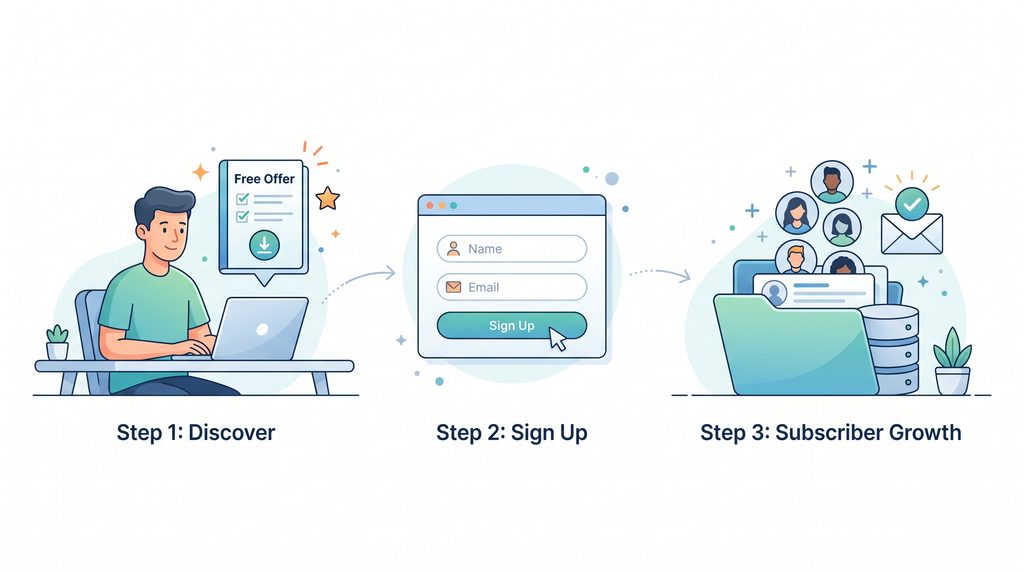
Step 4. Channels that bring in your first real subscribers
Once your funnel is ready, the question becomes: where do people come from? You don’t need a budget to answer that. A few focused channels are enough to build real momentum when you’re starting out.
Social media as a subscriber acquisition tool
Pin your landing page link in your bio on every platform you use. Create content that previews the value inside your lead magnet without giving it all away. Drop your opt-in link in Facebook Groups and LinkedIn posts where your target audience already spends time. Social media works as a subscriber channel when you treat it as traffic infrastructure, not just a content outlet.
Community and content-based list building
Guest posting on niche blogs, appearing as a podcast guest, and participating in Reddit threads or niche forums are all free and highly targeted. Each of these creates a direct path from an engaged, specific audience to your opt-in page. One well-placed guest post on a relevant blog can bring in more targeted subscribers than weeks of general social media posting.
Partnership-based subscriber growth
Find complementary creators or businesses with a similar audience and swap newsletter mentions. Offer to contribute a resource, a template, or a checklist to another creator’s audience. Participate in a giveaway where your lead magnet is one of the prizes. These partnership strategies cost nothing and work because they put you in front of an audience that already trusts the person introducing you. For hands-on funnel strategies and traffic partnerships, see Solo Ad Traffic: Crafting the Perfect Funnel, Working With Walter.
Step 5. Welcome your list and stay on the right side of the law
Getting subscribers is only half the work. Keeping them engaged and operating legally are the parts that determine whether your list actually becomes an asset.
Write a welcome sequence that actually builds trust
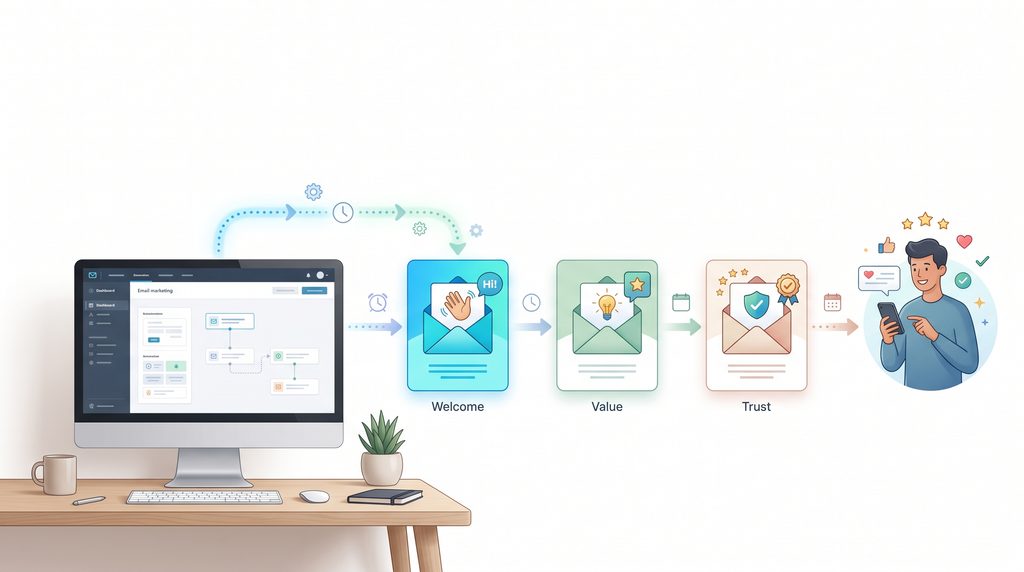
Your welcome email typically has the highest open rate of any email you’ll ever send, industry data consistently puts welcome email open rates well above the average for regular campaigns, often in the 50, 80% range, though your own results will vary by niche and list quality. Use that attention well. Email one delivers the lead magnet and sets expectations for what subscribers will receive going forward. Email two shares a helpful tip or a short personal story that establishes your credibility. Email three invites a reply or makes a soft offer. Many beginner-friendly ESPs offer basic automation on free plans, MailerLite and Sender both include it, but check your chosen provider’s feature set before assuming full automation is available at no cost.
CAN-SPAM, GDPR, and CCPA basics for US-based creators
Under CAN-SPAM, you do not need explicit opt-in consent to send commercial emails in the US, but every email must include a physical address and a working unsubscribe link. If you target EU residents, GDPR requires a clear, affirmative opt-in before you collect their address. California’s CCPA requires a notice at the point of collection and the ability for users to opt out of data sharing. A practical cross-jurisdictional habit: use an unchecked opt-in checkbox so subscribers actively consent, and link to a privacy policy on your signup form. Note that each law has specific requirements, CAN-SPAM’s physical address rule and CCPA’s notice-at-collection requirement still apply regardless of your checkbox setup, so review each regulation or consult a legal resource as your list grows. A concise primer on the differences and requirements is available in this guide to GDPR, CAN-SPAM, and CSA.
Deliverability basics that keep you out of spam
Before you send your first email, set up SPF, DKIM, and DMARC records for your sending domain. These authentication protocols tell inbox providers that your emails are legitimate. Start with small send volumes (around 50 to 100 emails) and increase gradually as your open rates confirm good engagement. Remove unengaged contacts regularly. These habits build sender reputation from the beginning, which is far easier than repairing a damaged one later. For guidance on warming a new sending domain and protecting deliverability, see this warming a new domain guide.
Get more people to find your list in the first place
Building a list is step one. Getting more people to discover it is what fills the top of your funnel consistently. Walter’s AgencyServicesGrp at agencyservicesgrp.com specializes in online visibility strategies designed to help small businesses get found by the right people, without relying entirely on SEO or paid ads. If you’ve built your funnel and you’re ready to drive real traffic into it, this is the natural next step. Check out what AgencyServicesGrp offers and see how better visibility can accelerate the list growth you’re working toward. If you’re also thinking about monetizing those subscribers, see How to Make Money Online With Your Own Email List For Side Hustle Income (opt-in), Working With Walter.
A realistic picture of what’s ahead
At a 3, 5% opt-in rate with consistent promotion across two or three channels, many people starting with no existing audience reach 1,000 subscribers within 6, 12 months. Favorable conditions, an existing social following, strong traffic sources, or a highly specific niche, can shorten that to 3, 6 months. Either way, the number is achievable without ad spend. What it actually requires is showing up regularly, not doing everything perfectly.
This guide on how to build an email list from scratch shows that the system itself is straightforward: an ESP, a focused lead magnet, a free landing page, a few acquisition channels, and a welcome sequence. That’s genuinely all you need to start. The list grows when the offer is clear, the promotion is steady, and you stop waiting for perfect conditions. Pick one step from this guide and do it today, the first subscriber is the hardest one to get, and everything after that is iteration.
Frequently asked questions
Do I need a website to start building an email list?
No. Free tools like MailerLite, Carrd, and Kit give you a shareable landing page URL without a domain or website. You can collect subscribers and send emails entirely through these platforms from day one.
What is the best free email marketing tool for beginners?
MailerLite and Sender are both strong starting points. MailerLite offers 1,000 free subscribers with landing pages and basic automation included. Sender gives you 2,500 subscribers free with unlimited automation workflows, one of the most generous free plans available right now.
How long does it take to reach 1,000 email subscribers?
For most beginners starting without an existing audience, 6, 12 months is a realistic target with consistent promotion across two or three channels and a solid lead magnet. If you already have a following or strong traffic sources, that timeline can compress to 3, 6 months. Organic growth typically starts at 50, 150 subscribers in the first two months, then accelerates as your funnel matures and you optimize what’s working.
What should I put in my first email to new subscribers?
Deliver the lead magnet you promised, introduce yourself briefly, and tell them what to expect from future emails. Keep it short and focused. Your first email has the highest open rate you’ll ever see, so use that moment to deliver immediate value and set a clear tone.
Is it legal to send marketing emails without asking for consent first?
Under US federal law (CAN-SPAM), explicit opt-in consent is not required, but every commercial email must include an unsubscribe link and a physical address. If you email EU residents, GDPR requires explicit opt-in. The safest practice for any audience is to use an unchecked consent checkbox paired with a link to your privacy policy.