What you'll walk away knowing
- Paid ads and directories produce measurable leads in days to weeks; email and social build momentum over 1 to 3 months.
- Facebook Ads average $27.66 per lead; Google Ads non-brand averages around $70.11; LinkedIn runs $100 or more per lead.
- Email marketing delivers strong ROI even with fewer than 500 subscribers, typically within 30 to 90 days.
- Google Business Profile is free, takes two hours to set up properly, and drives local calls without ongoing ad spend.
- Referral programs produce leads at roughly $10 to $25 each, far cheaper than paid advertising.
- Diversifying your marketing channels is risk management, not a bonus strategy.
If you're tired of waiting for Google, non-SEO marketing can deliver leads in weeks, not months. You spend months building out your website, optimizing title tags, chasing backlinks, and following every SEO checklist you can find. Then you wait. Six months later, you're still on page three, and the leads you need this quarter aren't coming. This is the reality for most small business owners who put all their growth eggs in the organic search basket.
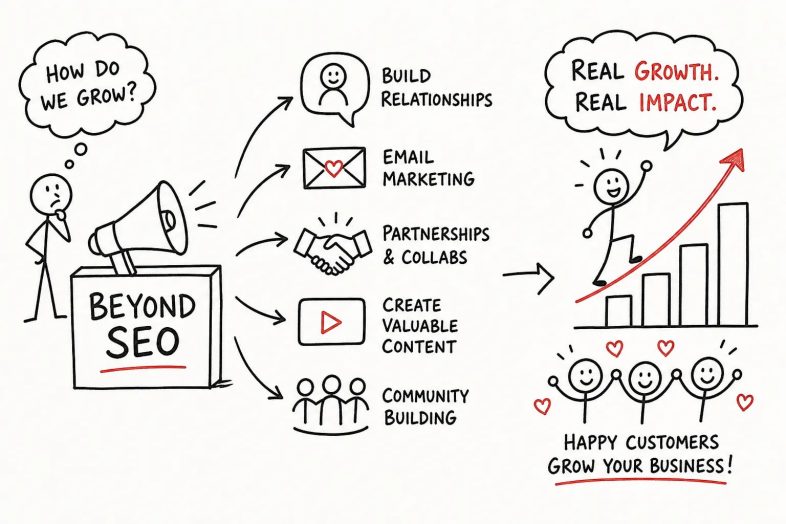
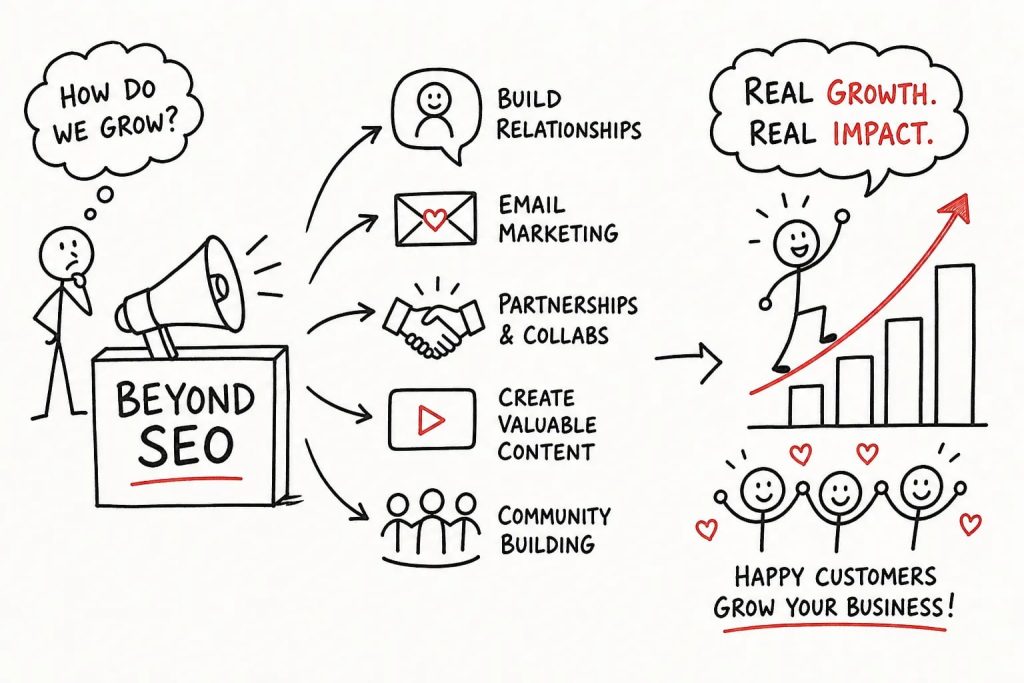
The good news: you don't need Google's permission to grow your business. Non-SEO marketing channels give you faster signals, more control over your results, and timelines measured in weeks rather than seasons. This article covers five channel groups: social media, email marketing, paid ads, online directories, and local partnerships. By the end, you'll know which two or three match your business and budget, what results to realistically expect, and exactly how to start within 30 days. Working With Walter exists specifically to teach these strategies in plain language to business owners who didn't grow up in digital marketing.
Why waiting on SEO is a real risk for small businesses
SEO timelines don't match small business cash flow
SEO is a compounding channel. It rewards patience and punishes businesses that need leads this quarter, not this decade. Organic search typically takes six to eighteen months before producing reliable lead flow. Paid digital ads, by contrast, show measurable signal within days to two to four weeks. Cold email outreach for B2B businesses can generate the first pipeline in one to four weeks. If your business needs revenue now, betting everything on organic search is a cash flow problem waiting to happen.
Algorithm dependence is a business risk
Building your entire growth strategy on a channel you don't control is a fragile plan. Google's algorithm updates can erase months of rankings with no warning and no recourse. Diversifying your marketing channels isn't a luxury feature for bigger businesses; it's basic risk management for any business that wants to stay afloat. Alternatives to organic search can absolutely hold their weight when executed correctly, and the businesses that build non-SEO marketing into their mix are far better positioned to weather algorithm volatility.
Social media and email marketing: start here
Social media gives you reach without a ranking
Social media is the lowest-barrier entry point for most small businesses. There's no technical setup required, audience targeting is built into every major platform, and organic posts can generate real engagement within hours of publishing. The mistake most business owners make is trying to be everywhere at once. Pick one or two platforms where your target audience actually spends time and show up consistently there.
The goal isn't to go viral. Consistent, useful content keeps your business visible to local followers, past customers, and warm prospects. Even a modest organic social presence reduces your dependence on search traffic, which means a Google update can't knock your entire lead pipeline offline in one morning. Influencer marketing follows the same principle at a larger scale: partnering with micro-influencers in your niche puts your business in front of an already-engaged, trust-primed audience without paying for clicks.
Email marketing builds the relationship that converts
Email is the highest-ROI non-SEO marketing channel available to small businesses. It reaches people who already raised their hand and said they want to hear from you. Building a small list doesn't require a big budget; a simple lead magnet, an opt-in form on your website, or an in-person sign-up sheet at your location gets the list started. A three-email welcome sequence that introduces who you are, what you do, and how you help is enough to start converting subscribers into customers.
Before you send a single email, set up SPF, DKIM, and DMARC authentication on your domain. This is a non-negotiable first step that protects your deliverability. Once you're sending, aim for a bounce rate under 2% and keep spam complaint rates below 0.1%. Track reply rate over open rate; replies tell you whether your content actually resonates, not just whether someone clicked a notification.
Learn these channels without the overwhelm
Working With Walter breaks down both email and social in plain language built specifically for small business owners, no agency jargon, no assumed technical background. It's where business owners learning these non-search marketing strategies from scratch go to build toward consistent, sustainable lead flow.
Paid advertising: real timelines and real numbers
What Facebook, Google, and LinkedIn ads actually cost
Before you spend a dollar on paid ads, know your planning benchmarks. Facebook Ads average $27.66 per lead with a conversion rate around 7.72% for lead generation campaigns. Google Ads non-brand search runs closer to $70.11 per lead with a conversion rate of roughly 3 to 6%. LinkedIn Ads sit at $100 or more per lead, with conversion rates between 5 and 15% depending on the offer and targeting. (These figures are drawn from widely cited platform benchmark reports; your actual numbers will vary by industry and campaign quality.) Treat them as directional planning inputs, not guarantees.
Google captures existing demand: people already searching for what you sell. That's why it tends to convert faster but costs more per click. Facebook and Instagram work better for creating demand and reaching people before they start searching. Both have a place in a well-rounded paid strategy; the right choice depends on where your buyers are in the decision process when you reach them.
Retargeting: the most cost-efficient paid ad tactic
Retargeting means showing ads only to people who have already visited your website or engaged with your social profile. Because you're reaching warm traffic already familiar with your business, retargeting typically delivers among the lowest cost-per-conversion figures in a paid advertising mix. A small Facebook retargeting campaign with a $5 to $10 daily budget produces measurable signal within two weeks. Start there before scaling anything else.
When paid advertising vs. SEO actually makes sense
The decision isn't complicated. If your business needs leads in the next 30 to 90 days, paid search or paid social is the right tool. If the goal is long-term brand presence over 12 months or more, a hybrid approach that combines paid with organic channels works better. Use paid to generate revenue while your other channels build momentum. This is how small businesses compete against larger competitors without matching their budgets dollar for dollar. Think of it as direct response marketing: every dollar spent has a measurable outcome tied to it.
Online directories and local partnerships: underrated channels
Getting listed where customers actually search
For local service businesses, online directories drive real calls and real foot traffic. Google Business Profile, Yelp, Bing Places, Nextdoor, Angi, Thumbtack, and HomeAdvisor all act as high-intent discovery channels for buyers who are ready to hire someone right now. A complete, review-rich listing often outperforms a brand-new website for local intent searches because the buyer trust is already baked into the platform.
Start with Google Business Profile. Claim it, fill in every field, add photos, and request five reviews from past customers. This takes roughly two hours and can produce results within days for local searches, with zero ongoing ad spend required. Once that's live and complete, add Apple Business Connect and Bing Places for additional free visibility. For trade-based businesses, Angi and Thumbtack are lead marketplaces worth exploring as your next step.
Referral programs and local partnerships that send you leads
Referral leads average between $10 and $25 each, a fraction of what paid advertising costs. The setup is straightforward: identify two or three complementary, non-competing local businesses that serve the same customer you do, then build a simple reciprocal referral agreement with a small incentive attached. A landscaper and a fence installer serve the same homeowner. A bookkeeper and a business attorney serve the same small business owner. The relationship investment happens upfront, but the ongoing cost is essentially zero.
A two-partner referral network can generate three to five qualified leads per month for a service-based business without any ad spend. These leads also convert at higher rates because they arrive with built-in trust from the referring business. That combination of low cost and high conversion makes referrals one of the most underused channels in small business marketing.
How to pick your channels and launch in 30 days
Step 1: Match channels to your business type and budget
Use this framework to self-select without guessing. A service business with no ad budget starts with Google Business Profile plus a small email list, both are free to set up and can produce results within 30 days. A retailer or product business with a modest budget adds Facebook Ads to that foundation. A B2B consultant prioritizes LinkedIn outreach and cold email, where direct conversation drives pipeline faster than any platform algorithm. The logic is simple: go where your buyers already are and start with what costs the least to test.
Step 2: Set your KPIs before spending a dollar
Each channel has metrics that actually matter, and knowing them upfront keeps you from chasing vanity numbers. For email, track bounce rate and reply rate. For paid ads, track cost per lead and conversion rate, these two numbers tell you whether a campaign is worth scaling. For directories, track call volume and review count. For social, track reach and direct message inquiries. Tie every metric to a business outcome. Impressions don't pay invoices; qualified leads do.
Step 3: Review weekly and optimize monthly
Build a 30-minute weekly review into your schedule. Check what's producing qualified leads, cut what isn't, and put more resources into the channel with the lowest cost per qualified lead. This weekly rhythm is how small businesses stretch limited budgets further than larger competitors with bigger teams. Thirty days of real data beats another month of planning.
Ready to build your visibility without relying on Google?
Building and managing these non-SEO marketing channels takes time that most small business owners simply don't have. Walter's AgencyServicesGrp handles online visibility strategy for small businesses so owners can focus on running their business instead of figuring out which platform to post on next. Visit agencyservicesgrp.com to explore done-for-you options designed specifically for small business owners who want results without the learning curve.
Frequently asked questions about non-SEO marketing
Is non-SEO marketing worth it if I already rank on Google?
Yes, without question. Diversification protects you from algorithm changes that can erase rankings overnight. It also opens channels that SEO simply can't reach: past customers via email, local buyers via directories, and warm referrals through partner networks. Ranking well on Google is an asset; depending on it entirely is a vulnerability.
How much should a small business budget for paid ads?
Start with $300 to $500 per month on a single platform. Run it for 30 to 60 days, measure your cost per lead, and scale only what's working. Starting small lets you gather real data before committing larger budgets to a channel or campaign you haven't tested yet.
Can email marketing work with a small list?
Absolutely. A list of 200 engaged subscribers outperforms a list of 2,000 disengaged ones. Email ROI depends far more on relevance and automation than raw list size. Focus on quality from day one, send consistently, and results follow within 30 to 90 days even at small scale.
How long before non-SEO marketing produces results?
Paid ads and directories show measurable signal in days to weeks. Email and social build momentum over one to three months with consistent execution. The exact timeline depends on your business model; ecommerce tends to see faster ROI than high-ticket services with longer sales cycles.
Start with one channel this week
Non-SEO marketing isn't a backup plan for when Google lets you down. For most small businesses, it's the primary growth strategy because it produces results within a timeline that actually matches cash flow and business reality. You now have a clear picture of five channel groups: social media, email, paid ads, directories, and local partnerships. You know the cost benchmarks, the realistic timelines, and the KPIs worth tracking.
The 30-day launch framework is straightforward: pick your channels based on business type and budget, set a single KPI per channel before spending anything, and review results weekly. That's the whole system. Working With Walter covers every one of these topics in plain, jargon-free guides built for business owners at every stage. Pick one channel this week, set one KPI, and measure it for 30 days. Thirty days of real data will tell you more than any amount of planning ever could.