Key takeaways
- Google Business Profile optimization is the single highest-ROI free visibility move available to any local business. If you haven’t claimed and completed yours, that’s your first step.
- NAP consistency (name, address, phone) across all directories is a quiet but significant local search trust signal. Mismatched data costs you ranking.
- Email is the only marketing channel you fully own. Social platforms change their algorithms; your email list stays yours regardless.
- Posting on one social platform three to four times per week generally outperforms scattered posting across five platforms for most small businesses.
- Community partnerships and local group participation generate low-cost visibility and build trust in ways that complement paid advertising.
- Most strategies in this article cost nothing but time. If you add paid advertising later, start with $300 to $1,000 per month to test before scaling.
- A 30-day action plan requiring 30 to 60 minutes per day is enough to move the needle on all four visibility pillars.
You set up your Facebook page, listed your business on Google, and posted a few times. The phone stayed quiet. That frustration is real, and most marketing advice glosses right over it instead of addressing it honestly.
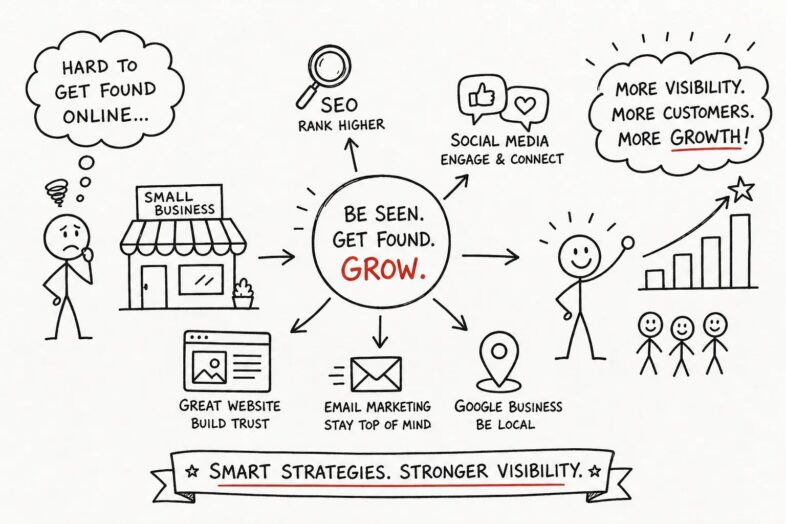
The good news: digital visibility strategies for small business owners don’t require an agency retainer or a full marketing team. They require four specific moves, executed consistently and in the right order. That’s the principle behind everything published at Working With Walter, a resource built for small business owners who want a practical roadmap, not a lecture about brand awareness.
This guide covers the four pillars that produce the most visibility for the least investment: local listings, focused social media, email marketing, and community-based outreach. By the end, you’ll have a clear 30-day action plan and the KPIs to know whether it’s working.
Start where your customers are already searching
Before you invest time in any other channel, your local listings need to be accurate and complete. Roughly 56% of U.S. small businesses haven’t claimed their Google Business Profile. That means more than half of your local competitors are invisible on the most important local discovery tool available, a genuine opportunity if you move first.
Claim and complete your Google Business Profile
Google Business Profile optimization consistently produces the fastest visibility lift for local businesses. It directly affects whether you appear in Google Search, Google Maps, and the local three-pack. A complete profile outperforms a bare-bones one in every category, including clicks, calls, and direction requests.
The order matters here. Verify the profile first, then set the most specific primary category for your business, correct all your business information, and upload several high-quality photos. Then start requesting reviews. “Complete” means every field filled in: services, business description, hours, attributes, and service areas. A blank description with no photos is a placeholder, not a profile.
Get your business information consistent everywhere
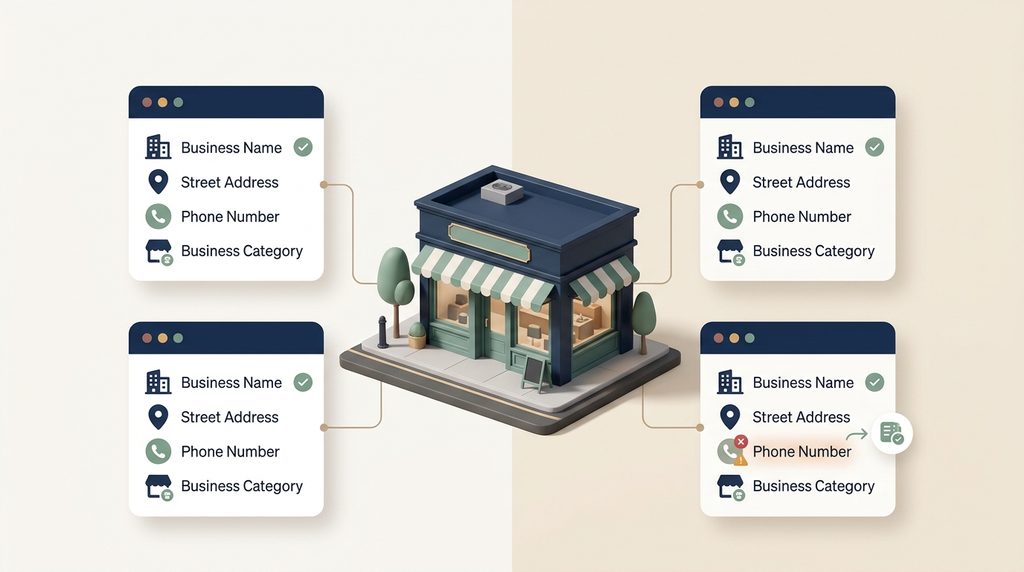
NAP consistency functions as a trust signal in local search. When your business name, address, and phone number match across Google, Yelp, Bing Places, Apple Business Connect, and Facebook, search engines treat your business as a reliable local entity. When the information conflicts, that inconsistency quietly suppresses your visibility.
Start with the five highest-impact directories: Google Business Profile, Apple Business Connect, Bing Places, Yelp, and Facebook. Then audit any industry-specific directories relevant to your category. Adding LocalBusiness schema markup to your website can strengthen local entity signals further. Implementation complexity depends on your platform, WordPress users can handle this with a plugin, while some custom-built sites may still need a developer’s help.
Build your reviews steadily, not in bursts
Review activity, both volume and response rate, supports local search ranking and customer trust. Higher review volume paired with a strong rating generally improves both trust and local performance, and research consistently shows that review counts influence which businesses appear in the local three-pack.
Keep the ask simple. After a service call or transaction, send a short message: “We’d love a quick Google review if you have a minute.” Respond to every review you receive, including negative ones. Responding signals to Google that the profile is active and managed, and it shows potential customers that you take feedback seriously.
Digital visibility strategies for small business owners: Pick one social platform and actually commit to it
The instinct to post everywhere is understandable. The results are almost always the same: thin content across multiple platforms, no real traction anywhere, and a business owner who burns out and goes quiet after three weeks. One platform done well beats five platforms done poorly.
How to choose the right platform for your business type
The right platform is wherever your specific customers already spend time. Facebook often works well for local service businesses and older-demographic customers. Instagram and TikTok work for visually driven businesses like restaurants, fitness studios, and home design. LinkedIn fits consultants, B2B providers, and anyone selling to other business owners.
If you’re unsure, audit your last ten customers and ask where they heard about you, that answer is usually more useful than any platform comparison chart.
What consistent posting actually looks like in practice
Three to four posts per week on one platform generally outperforms daily posting spread thin across four. A simple content rhythm that works: one educational post, one behind-the-scenes or story-driven post, and one promotional post each week. That cadence is sustainable without producing content fatigue.
Batch your content in one weekly session. Spend 60 to 90 minutes writing captions and scheduling posts using Meta Business Suite (free) or a tool like Buffer. Short-form video, specifically Reels and TikToks, generates meaningful organic reach even with phone-only production. Respond to comments and DMs the same day; engagement matters as much as the content itself for algorithmic visibility.
Build an email list you fully own
Every social platform you depend on can change its algorithm, restrict your reach, or disappear. Your email list exists outside all of that. It belongs to you regardless of what any platform decides to do next, and that ownership has real financial value.
Why email outperforms social for retention
Email delivers approximately $36 to $42 in revenue for every $1 spent, making it one of the highest-ROI channels in affordable digital marketing for small businesses. You don’t need a large list to see real results. Even a small group of engaged subscribers, say, 200 people, can drive consistent revenue for a local service business, because the intent level is fundamentally different from social media followers. That said, actual revenue impact depends on your average transaction value and how often you send, a simple way to think about it: even a 2% conversion rate on a $200 service among 200 subscribers adds up quickly.
Email subscribers chose to hear from you. Social followers scroll past your content. That intent gap is why email consistently outperforms social media for customer retention and repeat revenue.
Simple ways to start growing your list today
You don’t need a complex funnel to get started. A lead magnet (a discount, a helpful checklist, or a short guide), a sign-up form on your website, and a verbal ask after a service call will build your list steadily. Email marketing tools for lists under 500 subscribers typically cost between $0 and $30 per month, which removes the budget objection entirely.
Start with a free plan and upgrade only when the list justifies it. SMS works well as a complement for time-sensitive promotions, but keep email as your primary owned channel.
What to send and how often when you’re just getting started
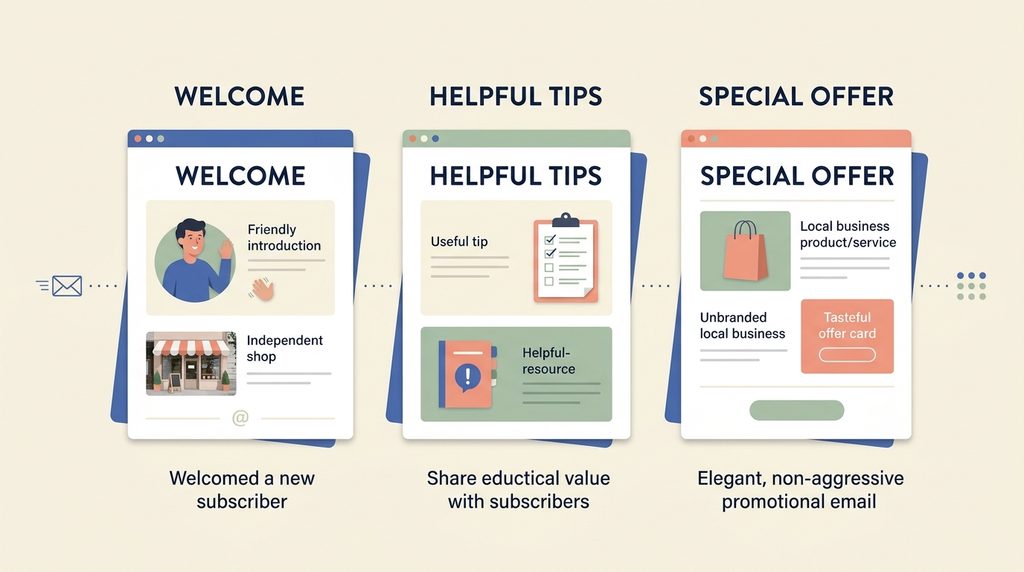
A biweekly cadence is often more sustainable for small teams than an ambitious weekly schedule that gets abandoned by month two. Start with three email types: a welcome email for new subscribers, a value-focused email that helps them solve a real problem, and a promotional email tied to a specific offer. Consistency and usefulness matter far more than design or length.
Grow through community and local connections
Community-based marketing is the most underused visibility channel for small businesses. It costs almost nothing, and it builds the kind of trust that paid advertising struggles to create because it’s grounded in real relationships.
Cross-promotions with complementary local businesses
Partner with non-competing businesses that share your customer base. Consider pairings like:
- A personal trainer and a local smoothie shop
- A contractor and a real estate agent
- A bookkeeper and a business attorney
The formats are simple: a shared social post, a joint email to both lists, or a referral agreement that costs nothing but goodwill. Keep in mind that while the monetary cost is minimal, these partnerships do require time and coordination, a shared post or joint email typically takes two to four hours to plan and execute. That investment generally pays off through expanded reach and credibility built through association.
Online community groups and local forums
Facebook Groups, Nextdoor, and local subreddits give you direct access to the neighborhoods you serve. The rule is straightforward: show up genuinely, answer questions, and provide value before you promote anything. Business owners who participate as helpful experts build local authority that compounds over time.
Spamming a local group with “Call us today!” posts gets you ignored or removed. Answering questions about your area of expertise gets you remembered and referred.
When DIY isn’t the right fit: professional implementation support
Implementing all four visibility pillars takes real time, and not every business owner has it to spare. If you’re ready to move faster than the self-managed approach allows, AgencyServicesGrp (agencyservicesgrp.com) offers hands-on online visibility services for small and medium-sized businesses. Working With Walter gives you the strategy framework; AgencyServicesGrp can handle execution so you can focus on running your business.
Track the numbers that tell you something real
More data is not the same as more clarity. Track a short list of meaningful KPIs and review them on a cadence that informs real decisions without creating noise from daily fluctuations.
The visibility metrics worth checking regularly
Your core visibility dashboard should cover five areas:
- Organic traffic
- Impressions and click-through rate
- Google Business Profile actions (calls, direction requests, and website clicks)
- Email open rate
- Review count and average rating
Review traffic and impressions weekly. Review the full dashboard monthly. Drop what shows no movement after 60 days and double down on what produces results.
Your 30-day visibility action plan
- Week 1: Claim, complete, and verify your Google Business Profile. Audit directory listings for NAP consistency across Google, Yelp, Bing Places, and Apple Maps. This is where online presence tips for SMBs have the most immediate impact.
- Week 2: Choose one social platform. Batch a month of content in a single session. Request reviews from your five most recent customers.
- Week 3: Set up email capture on your website or at the point of sale. Send a first email to existing contacts. Join one local community group and start participating as a helpful resource.
- Week 4: Reach out to one complementary local business about a cross-promotion. Review your GBP analytics. Identify what to double down on in month two based on what moved.
This plan runs on 30 to 60 minutes per day. You don’t need more time than that to execute it well.

Conclusion
The most effective digital visibility strategies for small business owners aren’t complicated, they’re consistent. Local listings, one focused social platform, email, and community outreach: that combination builds compounding visibility without requiring a large budget or a full marketing team.
When you need a deeper dive on any of these strategies, Working With Walter is the resource to return to. The guides there are built specifically for small business owners who want practical steps, not theory. And when you’re ready to hand off the implementation work, AgencyServicesGrp (agencyservicesgrp.com) offers visibility services built for SMBs.
Start with your Google Business Profile today. Even if you do nothing else this week, claiming and completing that profile puts you ahead of more than half your local competitors immediately.
Frequently asked questions
How long does it take for digital visibility strategies to show results?
GBP improvements and review collection can affect local search visibility within a few weeks. Local SEO for small business owners typically takes two to four months to show meaningful traction. Social media consistency compounds over 60 to 90 days of regular posting.
What is the most important visibility strategy for a brand-new small business?
Google Business Profile, without question. It’s free, it directly affects whether you show up in local search and maps, and it produces results faster than any other tactic on this list. Complete it before you invest time anywhere else.
Do I need a website to implement these strategies?
Not immediately. GBP, social media, email platforms, and community marketing all work without a website. A simple website strengthens local SEO over time, but it isn’t a prerequisite for starting. Build visibility first; add the website when it makes sense.
How much should a small business budget for digital marketing each month?
Most of the strategies in this article cost nothing but time. If you’re ready to add paid advertising, a realistic starting budget is $300 to $1,000 per month for testing. Focus on free channels first until you understand what actually converts for your business.
How does Working With Walter help small business owners with digital visibility?
Working With Walter publishes practical, step-by-step guides on local SEO, email marketing, social media strategy, and lead generation written specifically for small business owners. The focus is on small business digital marketing strategies that are actionable and low-cost. For hands-on implementation support, AgencyServicesGrp (agencyservicesgrp.com) offers visibility services built for SMBs who want professional execution without agency-level overhead.