Key takeaways
- Referrals close at 50, 70% in B2B and professional services, making them the highest-ROI lead source for those sectors, and a strong performer across most small business types.
- Contacting a new lead within 5 minutes makes you 21x more likely to convert them.
- Email marketing delivers leads at $7, $53 per lead, one of the lowest costs of any channel, owned or paid.
- Your Google Business Profile is one of the most powerful local lead generation tools available, and one of the most frequently under-optimized.
- You need three things to build a real system: a capture mechanism, a follow-up sequence, and a referral trigger.
Small business lead generation isn’t the problem, your system is. Most small businesses collect a few referrals one month, post on social the next, run a one-time ad, and then wonder why revenue feels unpredictable. The issue isn’t effort. It’s the absence of a repeatable framework.
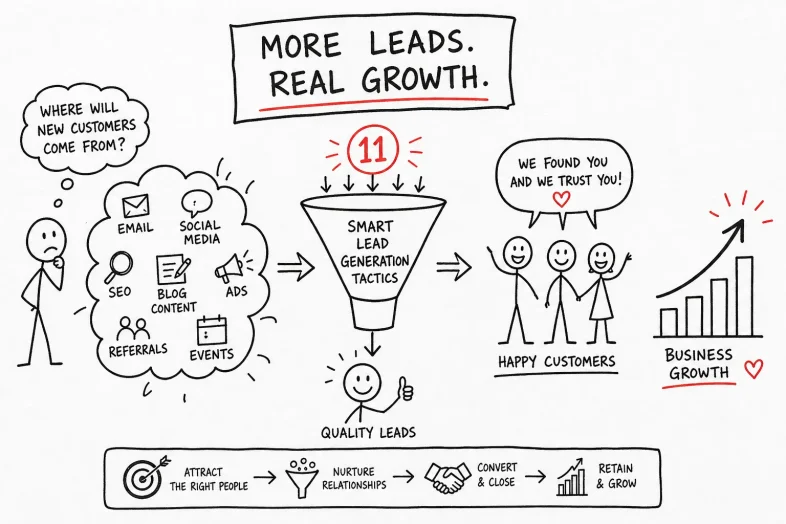
This guide covers 11 lead generation tactics that work in 2026, organized from highest-converting to most scalable. You won’t need a big budget or a marketing agency to start. What you do need is a system you actually stick to.
For small business owners who want to go deeper on any tactic here, Working With Walter has step-by-step guides on email marketing, local lead generation, and online visibility built specifically for businesses like yours. Think of it as your resource hub as you build your system. By the end of this article, you’ll have three prioritized tactics, specific tools to run them, and a clear way to measure whether they’re working.
Why inconsistent lead flow is a systems problem, not a luck problem
Most owners generate leads reactively. When business slows, they scramble. When business is good, they stop. That cycle creates the feast-or-famine pattern that kills cash flow. The core issue is always the same: no lead capture mechanism, no follow-up process, and no referral trigger built into their workflow.
The fix is a “lead generation stack”, a layered system where three or four tactics work together instead of in isolation. Think of it like a conveyor belt. One tactic attracts attention, another captures contact info, and a third converts that contact into a paying customer. Each layer supports the others.
The 5-minute response window that most businesses ignore
Here’s a number worth printing out and taping to your monitor: leads contacted within 5 minutes are 21x more likely to convert than leads followed up at 30 minutes. The problem isn’t getting the lead. It’s the delayed response that kills the deal before you even know it died.
A basic CRM with an auto-response feature helps reduce lead attrition and buys time for a human follow-up. The moment someone fills out your contact form, they receive a confirmation message and a realistic timeframe for your call. Fix your inbound response system before you build any outbound tactics.
Small business lead generation strategies that convert: tactics 1 and 2
How to build a referral program that runs on autopilot
In B2B and professional services, referrals close at 50, 70%, far above the rates most cold outreach approaches achieve, which often land well under 30% depending on method and industry. The reason is simple: trust transfers. When a current customer sends you a new lead, that prospect arrives with their guard already down. Results vary by sector, but across most small business types referrals consistently outperform cold channels on close rate.
A basic referral program needs three elements: a trigger (when to ask), an incentive (what you offer), and a mechanism (how customers send the referral). Keep it simple. Send a follow-up email 2, 3 days after service delivery with a direct ask and a small reward, a discount, a gift card, or a genuine thank-you. Tools like Referral Factory automate this process for a low monthly cost and track every referral without manual work on your end. For benchmarks on typical referral program performance and conversion rates, see the referral program benchmarks report.
Using Google reviews to pull in warm, ready-to-buy prospects
A fully optimized Google Business Profile with consistent reviews is one of the strongest local lead signals in 2026. Businesses that rank in the local 3-pack see significantly more inbound call volume than those that don’t. That visibility is free, you just need to claim and maintain it.
Ask for reviews at the point of highest satisfaction: right after delivery or project completion. Respond to every review posted, positive or negative. That response pattern signals to Google that your profile is active, and it shows prospects that you’re a business that actually cares about its customers. For a roundup of the recent platform updates and what to watch for this year, review the summary of the biggest changes to Google Business Profile in 2026.
Tactic 3 and 4: Email capture, small business lead generation you own
Setting up a lead magnet and capture form that convert
Unlike social media or Google, your email list is an asset you own outright. Platform algorithm changes don’t touch it. The lead magnets that consistently outperform generic offers share one trait: they match the specific problem the visitor is trying to solve right now, not a general problem adjacent to your service.
Practical examples by business type: a free checklist for home service businesses, a cost estimate template for contractors, or a “what to ask before hiring” guide for consultants. For tools, Carrd offers affordable landing page plans starting at $9/year, check current tier details to confirm form features for your use case. Pair it with Mailchimp to manage your list; their entry-level plan supports email capture and basic list management for getting started. Both are beginner-friendly and integrate without needing a developer.
The starter follow-up sequence that moves prospects toward a decision
Most small businesses capture an email and go silent, that’s where leads go cold. A short follow-up sequence fixes this without requiring a copywriter or a marketing degree. Three emails is a workable starting point; research on lead capture and nurturing for SMBs suggests 5, 10 emails is typical for a full nurture cycle, so treat this as your minimum test before expanding.
- Email 1: Deliver the lead magnet and introduce yourself briefly. Send immediately after signup.
- Email 2: Share one useful insight or a short case study. Send 2, 3 days later.
- Email 3: Include a clear call to action. Send 2 days after that.
Most email service providers, including Mailchimp, offer automation features that handle this sequence once it’s set up. Check your specific plan for automation availability, as features vary. Set it up once and it runs for every new subscriber automatically.
Tactics 5 and 6: Social media and local visibility that drive real inbound calls
Organic social media tactics that actually bring in local prospects
Social media works for small business lead generation when it targets the right local audience with content that proves expertise rather than just announcing services. Three approaches consistently produce results:
- Join and contribute to local Facebook groups without spamming, answer questions, share insights, build visibility
- Post before-and-after or process content on Instagram or TikTok to demonstrate your work in action
- Engage directly with people asking for recommendations in your service area
Response time matters here too. When someone tags your business or asks a question publicly, responding promptly signals professionalism and often converts a public comment into a private message that leads to a sale.
Google Business Profile optimizations that drive inbound calls
GBP consistently outperforms paid ads for local service businesses at the awareness and consideration stages. And it’s free. Key optimizations include filling every section completely, uploading as many high-quality photos as possible (profiles with substantially more photos tend to get more clicks), using Google Posts weekly, and enabling the messaging feature so prospects can contact you directly from your profile.
NAP consistency across your website, directories, and social profiles is a ranking factor most businesses overlook. Your name, address, and phone number need to match exactly everywhere they appear online. Consider adding location-specific landing pages if you serve multiple cities or neighborhoods, that single change can meaningfully improve your visibility in each market you serve.
Tactics 7 through 11: Affordable lead generation tools and real cost benchmarks for your lead gen stack
Free and low-cost tools worth building around
You don’t need 12 tools. You need one tool for each stage: capture, nurture, and convert. A focused starter stack looks like this: HubSpot CRM (free tier) for contact management and lead tracking, Mailchimp for email capture and sequences, Carrd (from $9/year) for a clean landing page, and Google Business Profile (free) for local visibility.
For businesses ready to invest slightly more, Pipedrive with the LeadBooster add-on adds chatbots and web forms. Hunter offers email prospecting capabilities on a free plan before scaling to paid. Start with the free stack, prove it generates leads, then add tools as your volume justifies the cost.
What leads actually cost by channel, and where to focus first
Before you spend a dollar on ads, understand what you’re comparing against. Here’s the small business customer acquisition cost per lead across major channels:
- Referrals: $25, $31 per lead
- SEO (organic search): $31, $35 per lead
- Email marketing: $7, $53 per lead
- Meta Ads: $27, $247 per lead
- Google Ads: $33, $350+ per lead
- Google Local Services Ads (pay-per-lead services for small business): $45, $85 per lead, benchmark and typical pricing estimates for Google Local Services Ads are summarized in industry writeups on Google Local Service Ads cost per lead.
For most small businesses under 10 employees, the move is clear: exhaust referrals, email, and GBP optimization before spending on paid ads. The free and low-cost channels deliver leads at a fraction of paid channel costs, and those leads often convert at higher rates because they arrive with more existing trust.
Once your organic system runs consistently, test a small Meta Ads or Google Local Services Ads budget of $200, $500 per month. Measure cost per lead against your revenue per customer. That ratio tells you exactly what to scale.
Need help getting your business visible online faster? Walter’s AgencyServicesGrp at agencyservicesgrp.com offers done-for-you online visibility services built specifically for small businesses. Start there before you spend a dollar on paid ads.
Questions and answers about small business lead generation
What is the fastest way to generate leads for a small business?
Ask your current customers for referrals and activate your Google Business Profile. Both tactics produce results within days and cost nothing. Referrals, especially in B2B and local services, close at rates well above most paid channels, because the trust is already built before the prospect picks up the phone. For a deeper playbook on outreach and selling to business customers, see our guide on how to sell to other businesses.
How much should a small business budget for lead generation?
Start with $0 by maximizing free channels: your Google Business Profile, referrals, organic social, and your email list. Once you generate consistent leads organically, test a small paid budget of $200, $500 per month on Meta Ads or Google Local Services Ads. Measure your cost per lead against your revenue per customer before scaling either channel.
What lead generation tactics work best for local service businesses?
Google Business Profile optimization, a referral program, and rapid inbound response are the three highest-ROI tactics for local service providers. Speed of response matters most. Following up within 5 minutes makes you 21x more likely to convert the lead compared to following up 30 minutes later.
How many emails should I send in a nurturing sequence?
Start with a 5, 10 email sequence and A/B test a shorter 3, 5-email variant if you want a minimal starting point. Space them 2, 3 days apart. Focus on delivering value in the first two emails before making any direct ask. Studies consistently show personalized subject lines outperform generic ones, often by 20% or more, so use the subscriber’s first name and reference the specific problem your lead magnet addressed.
Do I need a website to generate leads?
No. A fully optimized Google Business Profile, an active presence in local Facebook groups, and a simple Carrd landing page with an email capture form can generate leads without a traditional website. Many small businesses run their entire lead generation system through these three channels alone.
Build the system, then work the system
Small business lead generation isn’t about running every tactic at once. It’s about picking three that suit your business, building a repeatable system around them, and measuring what works. The businesses that win aren’t the ones with the biggest ad budget, they’re the ones with the most consistent intake process.
Here’s where to start: activate your referral ask this week, set up an email capture form with a starter follow-up sequence, and fully optimize your Google Business Profile. Those three moves cost almost nothing and form the foundation of every lead gen system worth building on.
As your business grows, Working With Walter has deeper step-by-step guides on each of these tactics, covering email marketing, local lead generation, and online visibility in plain language built for business owners, not marketers. Check the Lead Generation Archives for additional articles and templates you can use this week. Pick one tactic from this list and implement it this week, not next month. One tactic running consistently beats ten tactics planned and never executed.