Key takeaways
- Freelancing generates income faster: most beginners reach $500, $1,000/month within 3, 6 months, compared to 12, 18 months for affiliate marketing.
- Affiliate marketing has stronger passive income potential but requires months of content output before commissions arrive consistently.
- Both models can start with under $500 if you stay lean and avoid unnecessary tools.
- Freelancing trades existing expertise for money; affiliate marketing trades content creation and patience for commissions.
- Running both at once is a legitimate beginner strategy if you sequence them correctly: freelancing first, affiliate content second.
Most people treat this as a competition. Affiliate marketing versus freelancing, one wins, one loses. That framing isn’t useful, and it usually leads to analysis paralysis instead of action.
The real question is simpler: which model fits your life right now? At Working With Walter, this is one of the most common questions we hear from people starting out. They’ve seen both options. They’re not sure where to begin. They don’t want to waste six months on the wrong path. If you’re weighing passive income vs. active income, or trying to choose between freelance platforms and affiliate networks, this comparison gives you a straight answer.
This article compares both models directly across startup costs, income timelines, required skills, and first-month action steps. By the end, you’ll have a real answer, not just more information to sort through.
What each model actually demands from you
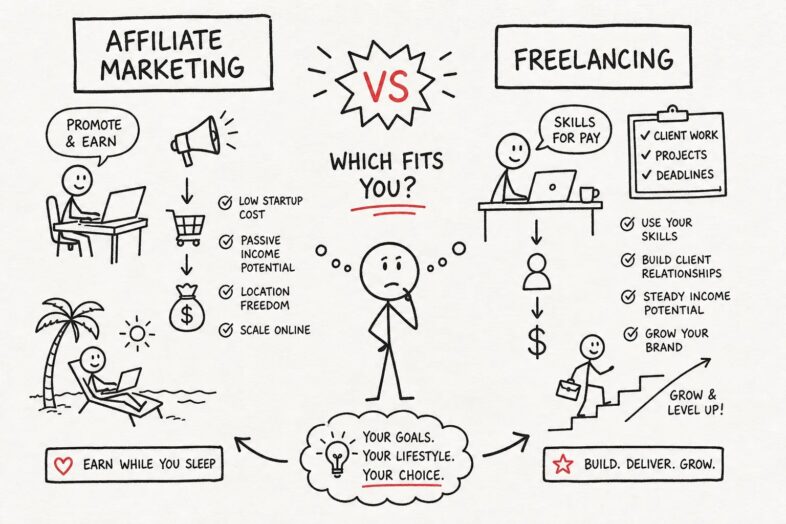
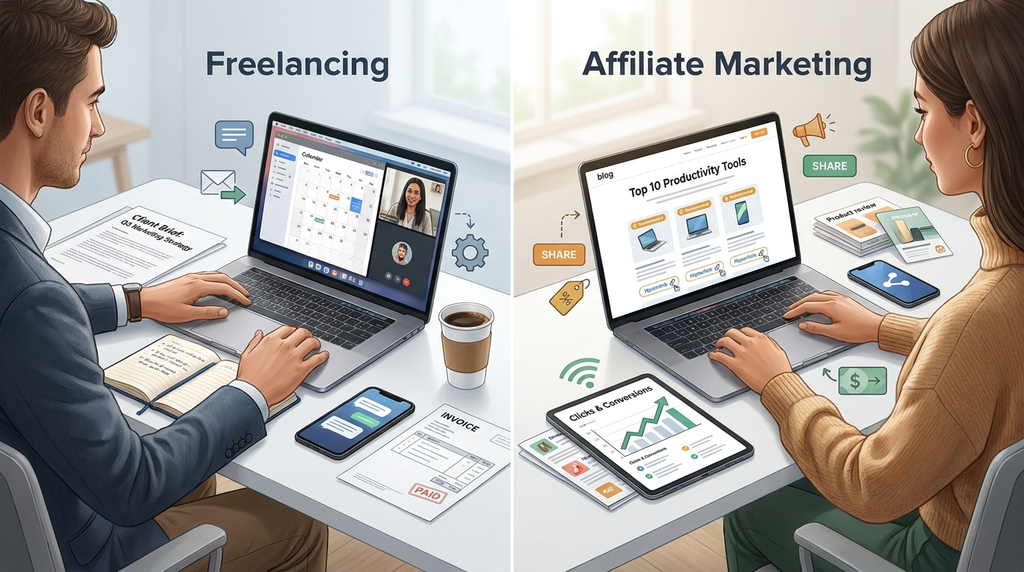
Here’s the core distinction: freelancing is active income. You work, you get paid. Affiliate marketing is commission-based income. You build, you wait, then it compounds. Neither model is easier than the other. They make different demands on your time, your skills, and your patience.
The skill and experience bar for each path
Freelancing requires a marketable skill you can sell immediately. Writing, design, virtual assistance, bookkeeping, social media management, and basic web work all qualify. You don’t need years of experience, but you do need a deliverable someone will pay for. Affiliate marketing requires content creation, basic platform understanding, and patience. No client relationships, no portfolio, no prior credentials required. Beginners with zero online history can start in affiliate marketing quietly, but they’ll wait longer to see a paycheck.
Time commitment: active hours vs. building time
A freelancer trades hours directly for income. Part-time freelancers typically put in about 10, 20 hours per week on client work and outreach, depending on their income goals. An affiliate marketer invests similar hours into content and audience building, but income doesn’t follow immediately, it lags behind effort by months. That’s the central tension here: one model pays now, the other pays later. Understanding that trade-off upfront keeps you from abandoning the right path too early.
Affiliate vs. freelancing: who each path is actually built for
Freelancing suits people who need income within 90 days, have a usable skill, and don’t mind managing client relationships. Affiliate marketing suits people who prefer to build once and earn repeatedly, can tolerate a slow start, and want income that doesn’t require trading hours for dollars long-term. Neither path is superior. They serve different situations, and your current situation should drive the decision.

The real cost of starting each path
Most articles undersell the real expenses involved in getting started. This section gives you the honest numbers so you can plan with accuracy rather than optimism.
What it costs to start freelancing in 2026
If you already own a computer and internet connection, your lean startup cost is close to $0. Add a simple portfolio page ($0, $200), a free contract template, and a basic invoicing tool like Wave (free), and you’re ready to pitch. The realistic beginner budget lands between $0 and $500 for most service-based freelancers. The bigger investment is time spent on proposals and building reviews on platforms like Upwork or Fiverr, not cash.
What it costs to start affiliate marketing in 2026
A lean affiliate setup typically runs $100, $500 to start. That covers a domain ($12, $200), basic web hosting ($0, $300), and a simple email tool ($0, $15/month). Costs climb if you add content tools, SEO software, or paid traffic, but none of those are required on day one. The real cost in affiliate marketing is time: months of content output before commissions arrive with any consistency.
Affiliate vs. freelancing: time to first dollar, side by side
Freelancers can earn within days of landing their first client. Reaching a steady $500, $1,000/month typically takes 3, 6 months for people starting out. Affiliate marketers usually see their first commission somewhere in months three through six, but reaching that same $500, $1,000/month level consistently takes 12, 18 months. That timeline difference is the most important data point in this comparison. Don’t let anyone soften it for you.
What income actually looks like in your first 12, 18 months
Realistic projections serve you better than motivational promises. Here’s what the numbers actually look like for beginners who stay consistent.
Freelancing income: what beginners actually earn in year one
Entry-level freelancers on Upwork and Fiverr typically start at $10, $25/hour. Working part-time at 20 billable hours per week, that’s $800, $2,000/month before platform fees and taxes. Those new to the model often reach $500, $1,000/month by month three as they accumulate reviews and refine their pitching. The ceiling rises quickly once you specialize and develop a steady client base. In-demand beginner skills like virtual assistance, social media management, transcription, and copywriting regularly clear $20/hour for starters who position themselves well.
Affiliate income: what the timeline really looks like
Most affiliate beginners earn their first commission in months three through six. Reaching $500/month consistently takes closer to 8, 14 months for content-based approaches. The $1,000/month mark often lands in the 12, 20 month range. Amazon Associates commissions vary widely by product category, many common categories fall in the 1%, 4.5% range, while rates overall span roughly 0%, 20% depending on what you’re promoting. ClickBank’s digital products offer 50%, 75% commissions, which can shorten the income timeline if your content drives traffic that converts. The compounding nature of affiliate content is real: income grows without proportional time increases, but only after the slow-build phase is behind you.
The long-term trade-off worth planning for
Freelancing income is predictable but requires ongoing effort to maintain. Affiliate income is unpredictable early but can scale without scaling your hours. Many experienced online earners run both, freelancing finances the first year while affiliate content compounds in the background. Plan for that sequencing from day one rather than stumbling into it later.
How to pick the right path for your situation
Stop hedging. Here are clear criteria so you can make a real decision today.
Choose freelancing if this describes you
You need income within 60, 90 days and have a skill someone will pay for right now. You’re comfortable pitching, communicating with clients, and delivering work on deadline, and you want predictability over passive potential. Freelancing is also the lower-risk entry point for anyone who hasn’t built an online audience yet, which describes most people starting out.
Choose affiliate marketing if this describes you
You’re not in urgent need of income in the next three months and you enjoy creating content, whether that’s writing, video, or email newsletters. You want income that doesn’t require trading time for money indefinitely, you’re drawn to commissions that arrive while you sleep, and you’re genuinely willing to wait 12, 18 months for that to become reality.
The case for starting both in the right sequence
Start with freelancing to cover income while you build affiliate content on the side. Cap your freelance hours at 10, 15 per week so you have time to publish consistently. Once affiliate commissions reach $500/month or more, you can reduce client work or raise your freelance rates. This sequence removes the financial pressure that kills most affiliate beginners in months four through eight. Both paths are covered in depth at Working With Walter, where practical, beginner-friendly guides walk you through either starting point without the fluff.
Your first 30 days: a simple starting point
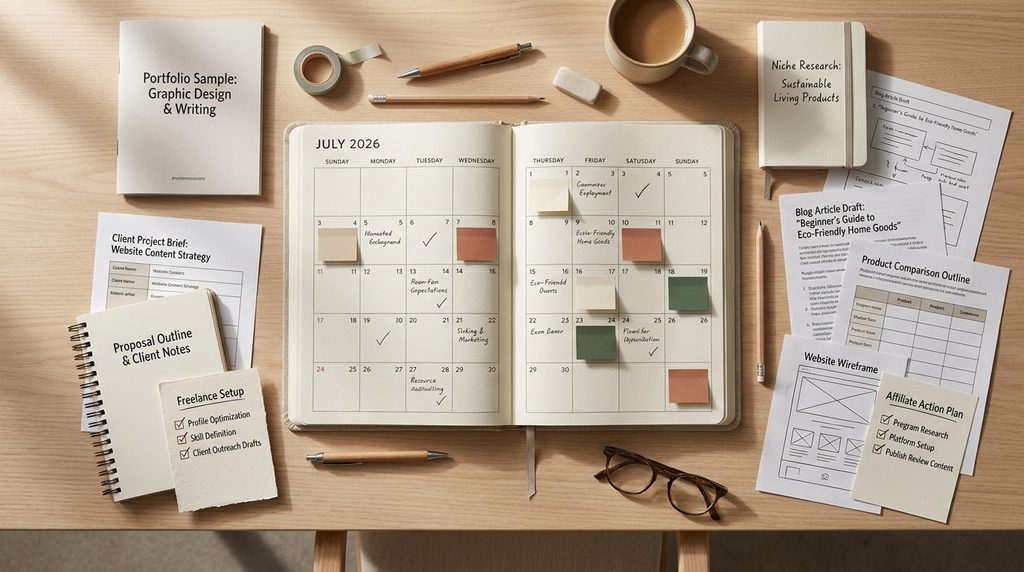
Freelancing path, days 1, 30: Identify one service, create two portfolio samples, set up a free Upwork or Fiverr profile, and send a high volume of proposals daily, many beginners aim for five or more to build momentum fast. Affiliate path, days 1, 30: Choose a niche, register a domain, set up a basic site, join one beginner-friendly network like Amazon Associates or ShareASale, and publish four pieces of content. Either path is manageable in one month if you commit to the daily output and resist the urge to over-prepare before you start.
Build your online visibility while you grow
Executing either plan becomes easier when people can actually find you online. Whether you choose freelancing, affiliate marketing, or both, your online visibility determines how fast your income grows. More visibility means more clients finding your profile, more readers landing on your affiliate content, and more trust established before someone ever reaches out to you.
If you want expert help building that visibility while you grow either income stream, the team at Working With Walter’s Agency Services Group can work with you on getting found, driving consistent traffic, and turning that traffic into real results. Reach out to Agency Services Group directly to learn how they can support your online presence without the guesswork.
Questions and answers
Is affiliate marketing harder than freelancing for a complete beginner?
Neither is harder in an absolute sense. They have different difficulty curves. Freelancing carries a steeper social barrier: you have to pitch, sell yourself, and manage client expectations. Affiliate marketing carries a steeper patience barrier: you build for months before income shows up. People starting out generally find freelancing easier to monetize quickly because the feedback loop is shorter.
Can I do affiliate marketing and freelancing at the same time?
Yes, and many beginners do. The practical approach is to start freelancing for immediate income, then invest a few protected hours each week into affiliate content. Once affiliate income becomes consistent, you can reduce client work if you choose. The mistake newcomers to either model commonly make is trying to run both at full intensity from day one, which leads to slow progress in both directions.
How much money do I need to start affiliate marketing with no audience?
A lean affiliate marketing setup costs $100, $500 to start. That covers a domain, basic hosting, and a free or low-cost email tool. You don’t need a large budget, but you do need consistent content output and time before income appears. Skipping the email setup is the one beginner mistake most worth avoiding early, building a list from day one often accelerates monetization meaningfully as your audience grows.
Which model is better for people over 40 who are changing careers?
Both are realistic options. Freelancing is often the faster bridge income for career changers because it lets you monetize existing professional skills without starting from zero. Affiliate marketing is a strong long-term path for building passive income that doesn’t depend on a traditional employer or client relationship. At Working With Walter, content is specifically written for this audience: people over 40 who want practical, no-fluff strategies that work with real-world time constraints.
How long before I can quit my job using affiliate income alone?
Many sources suggest it takes multiple years, often 2 or more, of consistent effort before affiliate income reliably replaces a full-time salary, though results vary greatly depending on niche, weekly hours invested, and audience trust built over time. Freelancing can reach that level faster, sometimes within 12, 18 months with full-time commitment. Plan for the longer timeline and treat anything faster as a bonus.
The bottom line on affiliate vs. freelancing
When you weigh affiliate vs. freelancing side by side, the right choice comes down to timing and temperament. If you need income in the next 90 days, start freelancing. If you can invest 12, 18 months building content before a reliable paycheck arrives, affiliate marketing is a legitimate long-term play. For many people, the smartest move is both, freelancing first to stay financially stable, affiliate content second to build something that scales. Working With Walter covers both paths in depth, so wherever you’re starting from, there’s a practical next step waiting for you.