Key Takeaways
- Affiliate marketing is performance-based: you earn a commission when someone buys through your unique tracking link.
- Niche selection is your most important first decision. Finance, SaaS, and digital products tend to deliver the highest earnings per click for beginners.
- Amazon Associates and ShareASale are among the easiest programs to join with no prior audience or traffic history.
- Most beginners using SEO-based content on a new blog report earning their first commission within 3 to 6 months, though results vary by traffic source and consistency.
- You can launch a functional affiliate site for as little as $4 to $7 per month with entry-level hosts like Hostinger or DreamHost.
- Disclosing affiliate relationships is an FTC requirement, not optional. According to FTC guidance, violations can cost up to $51,744 per infraction.
Most people who search “how to start affiliate marketing” end up closing tab after tab, more confused than when they started. That’s not a knowledge problem, it’s a structure problem. The information exists, but it’s scattered across hype-filled income reports, outdated forum threads, and courses that bury the basics under hours of upsells. If you’re an affiliate marketing beginner trying to cut through that noise, this guide is built for you.
Starting affiliate marketing doesn’t require a big audience, a technical background, or a large budget. What you do need is a focused niche, a platform to publish on, and a repeatable plan. That’s the framework this guide delivers, and it’s the same approach covered in depth at Working With Walter, where beginners trade guesswork for step-by-step execution.
By the end of this article, you’ll know how affiliate marketing works, how to select a niche that pays well, which programs to join first, and exactly what to do for your first 90 days. No hype: your first commission won’t arrive this week. But the path to it is clear, and this guide maps it out.
How Affiliate Marketing Actually Works
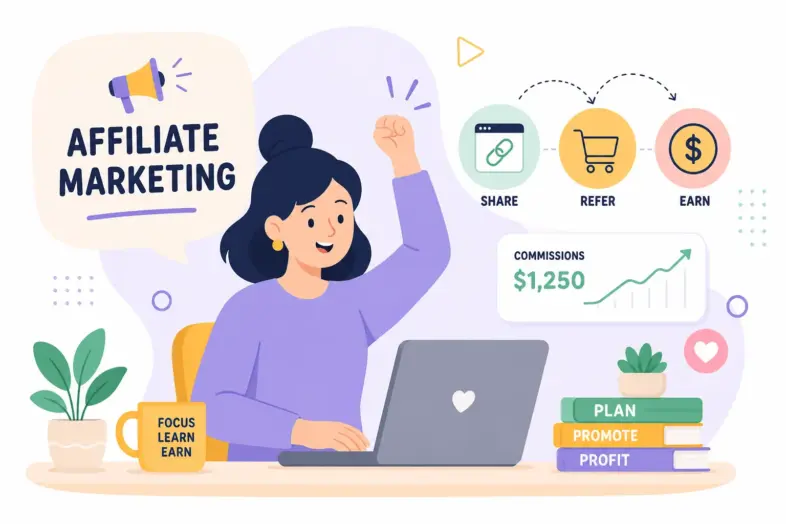
The model is straightforward. A merchant sells a product, you promote it as an affiliate using a unique tracking link, and when someone clicks your link and makes a purchase, you earn a percentage of the sale. You never touch inventory or deal with customer service and fulfillment headaches.
Four players make the system work: the merchant (the company selling the product), the affiliate (you), the affiliate network (the platform that manages tracking and payouts), and the customer. Most beginners work with networks like Amazon Associates, ShareASale, or ClickBank, which sit between you and the merchant and handle the mechanics automatically.
The Mechanics Behind the Commission
When a visitor clicks your affiliate link, a small file called a cookie gets stored in their browser. If they complete a purchase within the cookie window, you get credited for the sale. Amazon Associates gives you 24 hours (with a cart extension for items added during that window). ShareASale merchants typically offer 30 days. ClickBank extends that window to 60 days for digital products, giving buyers more time to decide. Cookie durations are set by each network’s policy and can change, so it’s worth checking each program’s current terms directly.
Commission structures vary by program. Some pay a flat fee per sale, others pay a percentage of the purchase price, and SaaS programs often pay a recurring monthly commission for as long as the customer stays subscribed. Recurring commissions are where long-term affiliate income really builds. Earning $30 per month from a single referral who stays subscribed for a year adds up to $360, which beats most one-time payouts over any meaningful stretch of time.
What You Actually Need to Get Started
You don’t need a massive website or an established following to start. At a minimum, you need a platform where you publish useful content and something genuinely helpful to say about the products you promote. A blog, a YouTube channel, or even a well-structured social profile can all work.
Set realistic expectations from the beginning. Affiliate marketing is not passive income on day one. It becomes passive over time, after you’ve built content that earns consistent traffic. The first months are active work. The payoff comes later, and it compounds.

How to Choose a Niche That Actually Pays
Niche selection determines almost everything: your competition level, your commission rates, and how quickly you build authority. Promoting random products across unrelated topics kills trust and confuses search engines. A focused niche lets you build credibility faster and attract an audience that actually buys.
Run every potential niche through a two-sided test. First, does the niche have products with meaningful commissions? Second, is there an active audience searching for help in that space? Both answers need to be yes before you commit.
High-EPC Niches Worth Considering
Based on widely reported commission benchmarks across major affiliate networks, a few niches stand out for new affiliates. Finance and investing programs pay $50 to $200 or more per lead because the customer lifetime value is enormous. SaaS tools like project management platforms and email marketing software commonly pay 20 to 30% recurring commissions monthly. Digital education products sold through platforms like ClickBank carry commission rates of 50 to 75%, far above what most physical product programs offer.
SaaS and digital education are two of the strongest starting points for beginners who want real income potential. The combination of high commissions and recurring payouts creates income that grows with your content library rather than resetting each month.
Avoiding the “Too Broad” Trap
The most common beginner mistake is targeting a massive niche like “health” or “personal finance” without a specific angle. Broad niches are dominated by authority sites with decades of content and thousands of backlinks. A brand-new site has almost no chance competing there head-on.
Narrowing your focus wins every time. “Fitness for men over 50” beats “fitness.” “Email marketing for local restaurants” beats “email marketing.” Use a simple gut-check: search your topic on Google. If the top results are all massive sites like WebMD, Forbes, or Healthline, you need to go narrower. The sweet spot sits at the intersection of a profitable niche and a specific audience you understand well enough to genuinely help.

Affiliate Marketing for Beginners: Platforms, Programs, and What to Join First
Your platform choice shapes your entire strategy. Realistic options include a blog, a YouTube channel, or a social media presence. For beginners with no existing audience, a blog paired with basic SEO is the most sustainable starting point, it captures search intent, which tends to convert better than most other traffic sources.
Beginner Affiliate Programs Worth Joining First
Start with programs that have low barriers to entry and trustworthy reputations. Here are four worth applying to in your first 30 days:
- Amazon Associates: One of the easiest networks to join with minimal barriers. Commission rates run 1 to 10%, but conversion rates are high because shoppers already trust Amazon. Good for building your first tracking experience.
- ShareASale: A large network with hundreds of merchants across nearly every niche. The interface is beginner-friendly and approval rates are generally generous.
- ClickBank: Well-suited for digital products and online courses. No lengthy approval process, and commission rates are among the highest available for beginners.
- PartnerStack: A go-to network for SaaS affiliates. Recurring commissions compound significantly over time, making it a solid choice for beginners targeting software tools.
How to Build Visibility as a New Affiliate
Creating content is only half the work. Getting that content seen requires a real visibility strategy, especially when you’re starting with a fresh domain and no social following. Most beginners underestimate this part, and it’s where momentum tends to stall.
If you want to accelerate your reach without spending months piecing together an SEO strategy on your own, the team at agencyservicesgrp.com works with affiliates and small business owners on online visibility, so you can focus on creating content while the traffic side gets professional attention. It’s worth exploring if you’d rather not go it alone on that front.
Your First 90 Days: A Simple Action Plan
Beginners don’t fail because they lack information. They fail because they don’t know what to do Monday morning. This section fixes that. Ninety days won’t make you rich, but for beginners working consistently on an SEO-based approach, a first commission within that window is a realistic goal, though it’s not unusual for the process to take closer to six months depending on your niche and traffic source.
Days 1 to 30: Build Your Foundation
Pick your niche, secure a domain and hosting (entry-level plans from hosts like Hostinger or DreamHost start at $4 to $7 per month), and install WordPress with a free theme. Apply to three affiliate programs from the list above. Before you publish a single word, set up Google Search Console and Google Analytics. Tracking from day one saves you enormous headaches later.
Spend the last week of this phase doing keyword research with free tools like Google Keyword Planner, Ahrefs Free Keyword Generator, and AnswerThePublic. Build a list of 10 to 15 content topics. Then focus your formats on “how to” and “best [product type] for [specific audience]” angles, these match high-intent buyer searches and tend to face lower competition for new sites.
Days 31 to 60: Publish and Activate
Publish your first five to ten pieces of content. Each post should include at least one affiliate link placed naturally within genuinely helpful writing. Place a clear disclosure at the top of every post, something like “This post contains affiliate links. I earn a commission if you buy through my links, at no extra cost to you.” This satisfies FTC requirements and builds reader trust at the same time.
Commit to a publishing cadence and stick to it. Two posts per week is realistic for most beginners working part-time. Consistency signals authority to search engines faster than sporadic content bursts, and it keeps momentum going when results aren’t visible yet.
Days 61 to 90: Drive Traffic and Refine
Share your content in relevant communities like Reddit and niche Facebook groups. Offer genuine help and mention your content only when it directly answers someone’s question. Spammy self-promotion gets you banned and damages your credibility.
Check your Google Search Console data to see which pages are getting impressions. Double down on topics where you’re showing up on pages 2 to 3 with additional content and internal links. If no commissions have come in yet, that’s normal for an SEO strategy in its first 90 days. Identify which posts get the most clicks, then optimize the affiliate link placement and calls to action on those pages first.

Common Questions from Affiliate Marketing Beginners
Q: How long does it take to earn my first affiliate commission?
Industry surveys suggest most beginners using SEO on a new blog see their first commission within 3 to 6 months. Beginners who already have an email list or social following can earn within days. The timeline depends heavily on your traffic source, not just the quality of your content.
Q: Do I need a website to start affiliate marketing?
Not always. You can promote affiliate links through a YouTube channel, an email list, or a well-built social media profile. That said, a website gives you the most long-term control and compound SEO value. It’s the platform most serious affiliates build toward, even if they start somewhere else.
Q: How much does it cost to get started?
A minimal setup, including a domain, shared hosting, and a free WordPress theme, costs roughly $4 to $7 per month with entry-level providers. You don’t need paid keyword tools or premium plugins to get started. Free tools like Google Keyword Planner and Google Search Console handle the essentials at no cost.
Q: Is affiliate marketing still worth it in 2026?
Yes. The fundamentals haven’t changed: high-quality, helpful content that matches search intent still converts. The saturation narrative scares off more competition than it should, which actually creates more opportunity for focused, consistent beginners who are willing to do the work.
Start Here, Not Somewhere Else
Affiliate marketing for beginners isn’t about gaming algorithms or chasing the hottest niche of the moment. It’s about choosing a focused topic, creating content that solves real problems, and letting the right people find it over time. The 90-day plan above is a starting point, not a finish line. Your first commission is a proof of concept, after that, the work shifts to refining what already works.
If you want curated, step-by-step resources that cut through the noise and give you a clear path forward, Working With Walter is where to start. The guides there are built for people who want practical direction, not theory. And if you need help getting your content seen faster, the team at agencyservicesgrp.com specializes in online visibility for affiliates and small business owners who are ready to grow.
Pick your niche, take that first step, and get moving, the path is laid out right in front of you.