Key takeaways
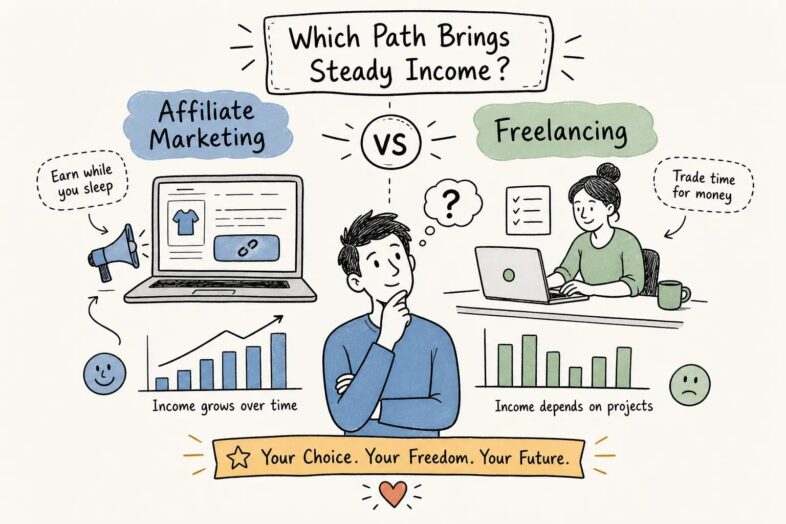
- Freelancing delivers income faster: most active beginners reach $1K/month within 1, 6 months, compared to 6, 18+ months for affiliate marketing
- Affiliate marketing has a higher income ceiling and scales without trading more hours for dollars
- Neither model is fully passive or fully predictable in the first 12 months
- Retainers (for freelancers) and email funnels plus SEO (for affiliates) are the top predictability tools in each model
- Your current cash cushion is the single biggest factor in which path to start with
Most people frame this choice as “which is better: affiliate marketing or freelancing?” That’s the wrong question when your savings account has a deadline. The right question is which one actually pays the bills while you’re building it. Understanding the real pros and cons of affiliate marketing versus freelancing for steady income means looking at timelines, cash flow patterns, and startup costs, not just which model sounds better on a podcast. Most online comparisons skip that part entirely. At Working With Walter, this is exactly the kind of decision we help people think through clearly, especially those starting over after a career change or layoff.
Both models work. Many people build full-time income from each path. The difference is how long you wait for that income to arrive and how stable it feels month to month once it does. Your current financial situation should drive this decision, not lifestyle aesthetics or what sounds exciting on a podcast.
Pros and Cons of Affiliate Marketing Versus Freelancing for Steady Income
How affiliate marketing actually generates income
Affiliate marketing is an asset model, not a labor model. You create content, drive traffic to it, and earn a commission when a reader clicks your link and buys something. The income compounds over time as your content library and audience grow, but that compounding takes months to show up in your bank account. Survey data shows that affiliates with less than one year of experience average just $636/month, while those with one to two years average $4,196/month, a steep ramp-up that rewards patience over quick exits.
That jump is real and worth chasing. But you need something to live on before it arrives. About 41% of affiliate marketers earn less than $1K/month, including roughly 23% who earn nothing at all. This is not a failure of the model; it’s simply what asset-building looks like in the early stage. The income eventually becomes largely independent of your daily hours, but the clock starts later than most people expect.
How freelancing generates income
Freelancing is a labor model: you trade a skill for payment, either per project or on a monthly retainer. The key advantage is speed. A beginner with a marketable skill can land a first paying client within two to four weeks on platforms like Upwork or Fiverr, even without a portfolio or established reputation. That direct exchange between skill and payment makes freelancing the faster path to real money in your account.
The catch is the income ceiling. Your available hours directly cap your income unless you build productized services or retainer arrangements. Without a retainer structure, project-based freelancers face the same feast-or-famine cycle that haunts affiliate marketers. You get busy, stop prospecting for new clients, finish your projects, and then scramble to refill the pipeline. The paycheck arrives faster, but income consistency requires active management.

Cash Flow Predictability: What to Actually Expect
Affiliate marketing: real upside, real volatility
In the first year, affiliate income is highly unpredictable. Seasonality, algorithm changes, and offer availability all create swings that even experienced affiliates deal with. Many beginners earn little to nothing in months one through three, then move into the $50 to $1,000/month range by month twelve if they stay consistent. At the intermediate stage, monthly income of $1K to $10K becomes achievable, but month-to-month swings remain common.
The income is not passive in the early stage. You spend real hours writing content, building an email list, testing offers, and optimizing conversion paths before the revenue becomes self-sustaining. The payoff comes later, but the work comes first. If you expect passive income on day thirty, the data suggests you’ll likely quit before the asset has time to compound.
Freelancing: faster stability but still feast-or-famine without a system
Freelancing can produce a predictable income, but only when you structure it intentionally. According to freelancer industry surveys, 77% of freelancers get at least half of their business from repeat clients. Freelancers who build retainer models report that 50 to 70% of their monthly income is predictable and recurring. That floor removes a lot of the financial anxiety that comes with project-based work.
Without retainers, though, project-based freelancers experience income swings just as dramatic as affiliate marketers, just on a shorter cycle. A $5,000 project is great until it ends and nothing fills the pipeline. Productized services, fixed-scope, standardized offers at a set price, reduce this volatility by making your service easier to sell repeatedly. The structure matters as much as the hustle.
What each model actually costs to start
Affiliate marketing typically costs $50 to $500 in the first year for a domain, hosting, and basic tools. SEO software, email marketing platforms, and content tools add ongoing costs ranging from free to several hundred dollars per month depending on your approach. Layer in paid traffic and those costs climb fast.
Freelancing can start with near-zero cash if you already have a skill and create a profile on a marketplace. The ongoing costs look different: platform fees, invoicing software, and proposal tools rather than hosting and SEO subscriptions. If you need income now and have little capital, freelancing is the lower-risk entry point from a pure cash perspective.

How long it actually takes to reach consistent earnings
The freelancing timeline: what the data shows
Freelancers consistently reach $1K/month within one to six months, with most active beginners landing there in two to three months. Reaching $3K/month typically takes six to twelve months. These timelines assume active client outreach, not passive waiting. “Consistent” means three or more months in a row above that target, not a single strong month followed by a drought.
The fastest path to stability in freelancing is converting your first project client into a retainer as soon as the engagement ends. One retainer at $3,000/month generates $36,000 in annual guaranteed revenue from a single client. Three clients at that rate create $108,000 in annual baseline revenue before any project work. Landing your first retainer is the most important milestone in a freelance business, and many beginners put it off far longer than they should.
The affiliate marketing timeline: the realistic picture
Reaching consistent $1K/month from affiliate marketing typically takes six to eighteen months. Reaching $3K/month consistently can take twelve to twenty-four months or more. The jump from $636/month in year one to $4,196/month in year two is real, but you need cash flow before that jump arrives. Data from a large cohort study of new affiliates found that about 81% quit before reaching twelve months, and the most common reason, cited by 31% of quitters, is that income didn’t arrive on the timeline they expected.
Three things accelerate the timeline: niche selection, email list building, and promoting high-commission recurring products. SaaS tools, personal finance offers, and online education programs pay recurring commissions and convert well because buyers have a clear problem and actively seek a solution. Starting in one of those categories rather than a broad lifestyle niche shortens the ramp considerably.
Choosing the right path or building both
Signs freelancing fits your situation right now
Choose freelancing first if you need income within 60 to 90 days, already have a marketable skill, or lack the cash runway to wait twelve or more months for affiliate income to compound. Freelancing also gives you something valuable for the long term: you learn exactly what your market needs and what problems people actually pay to solve. That on-the-ground knowledge is powerful data for anyone who eventually wants to build content or an affiliate strategy around the same audience.
For example, a freelance copywriter who spends six months writing email sequences for e-commerce brands gains direct insight into what offers convert and why, the kind of specificity that makes affiliate content far more credible than anything written from the outside looking in.
Signs affiliate marketing is the smarter long-term play
Choose affiliate marketing first if you have a cash cushion to cover twelve to eighteen months, want income that doesn’t scale with your hours, or operate in a content-friendly niche with strong search demand. Affiliate marketing also pairs naturally with a freelancing practice. You can build additional revenue streams around the same skill set or audience you already serve, creating a second income layer that grows independently over time.
How to get practical guidance without the guesswork
If you’re weighing the pros and cons of affiliate marketing versus freelancing for steady income and still aren’t sure which model fits your situation, Working With Walter offers no-fluff, practical guidance on both paths. This matters especially for people navigating this decision after a career change, a layoff, or a mid-life pivot. The goal is real answers based on your actual financial situation, not generic inspiration that sounds great and helps no one.
Whichever path you choose, your online presence is what makes it sustainable over the long term. If you want help building or strengthening that visibility, Walter’s AgencyServicesGrp offers hands-on online visibility services designed for exactly this kind of situation. Reach out to AgencyServicesGrp directly to explore how their team can build the digital foundation that makes either income model actually work.
Frequently asked questions
Can you do affiliate marketing and freelancing at the same time?
Yes, and many people structure it exactly that way. Start freelancing to create immediate income, then use your earnings and industry knowledge to build an affiliate content strategy on the side. The two models complement each other when you manage them carefully, and the market knowledge you gain from freelancing often makes your affiliate content more targeted and credible.
Is affiliate marketing or freelancing better for someone over 40 starting fresh?
It depends on your runway. If you need income fast, freelancing wins on timeline every time. If you have savings and a longer horizon, affiliate marketing can build compounding income that doesn’t require trading hours for dollars. Many people over 40 start with freelancing for immediate cash flow, then shift toward affiliate income as they build their content presence and email list over time.
How do retainers improve income predictability for freelancers?
Retainers convert one-time clients into recurring monthly revenue. Freelancers with strong retainer books report 50 to 70% of their income as predictable, which significantly reduces the feast-or-famine cycle. A well-structured retainer arrangement can anchor your baseline revenue from a single client relationship and change the entire financial picture of a freelance business, shifting the question from “where’s my next project?” to “how do I grow from here?”
What is the biggest reason affiliate marketers fail to reach consistent income?
Most quit before the asset has time to compound. The first three to six months rarely produce meaningful revenue, and without realistic expectations or a financial bridge, many people abandon the model too early. One large cohort study found that 81% of affiliate marketers quit within twelve months, and 31% cited unmet income expectations as the primary reason. The model works; the timeline just doesn’t match what most people anticipate going in.
The bottom line on this comparison
Neither model is universally better. The right choice is the one that fits your current cash position, timeline, and risk tolerance. Freelancing is faster but your available hours cap the ceiling. Affiliate marketing is slower but scales beyond what any single person can bill in a week. Both paths require real work and real time before the income becomes steady.
Use the decision criteria in this article to pick a starting point rather than staying stuck in research mode. The pros and cons of affiliate marketing versus freelancing for steady income only become clear when you measure them against your specific situation, not an abstract ideal. Pick the model that matches your current reality, take the first concrete step, and adjust as you learn.
Working With Walter has resources to help you think through that first step and the ones that follow. If you’re ready to stop comparing and start building, that’s exactly where to begin.