Key takeaways
- A complete digital presence strategy covers directories, social profiles, email, and content distribution, not just Google.
- Start by auditing what you already have before building anything new.
- Your email list is the only audience channel you fully own.
- You don’t need every platform. Pick two and do them well.
- Conversion rate, organic traffic, and engagement rate are the KPIs worth tracking.
- Review your plan every 90 days and cut what isn’t producing results.
A local contractor told me he spent eight months building his Google rankings from scratch. Page one, top three, steady call flow. Then a core algorithm update hit in early 2026, and his traffic dropped 60% in two weeks. His business didn’t disappear overnight, but his phone stopped ringing. That’s what happens when your entire digital presence strategy runs through one channel.
Most small business owners treat “digital presence” as a synonym for “Google ranking.” That’s a fragile position. Google can change its algorithm. A competitor with a bigger budget can outspend you. A de-indexing error can wipe out months of work. A real online presence strategy spreads your visibility across directories, social profiles, email, and content distribution so no single platform can knock you out.
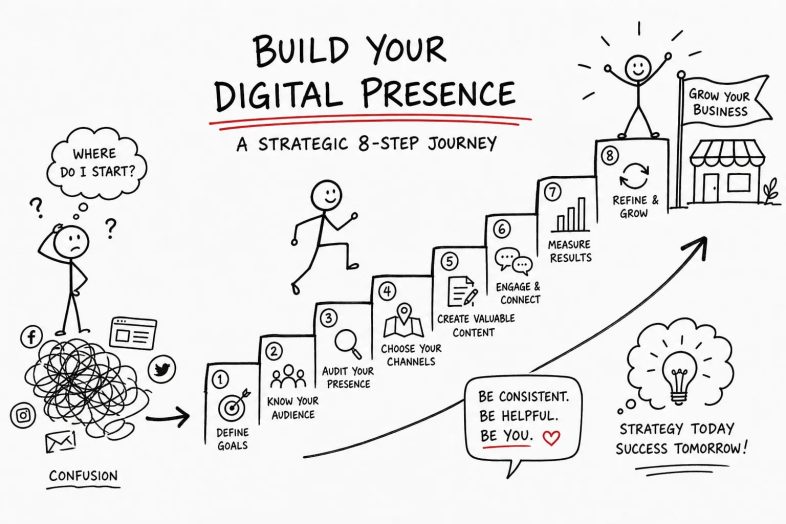
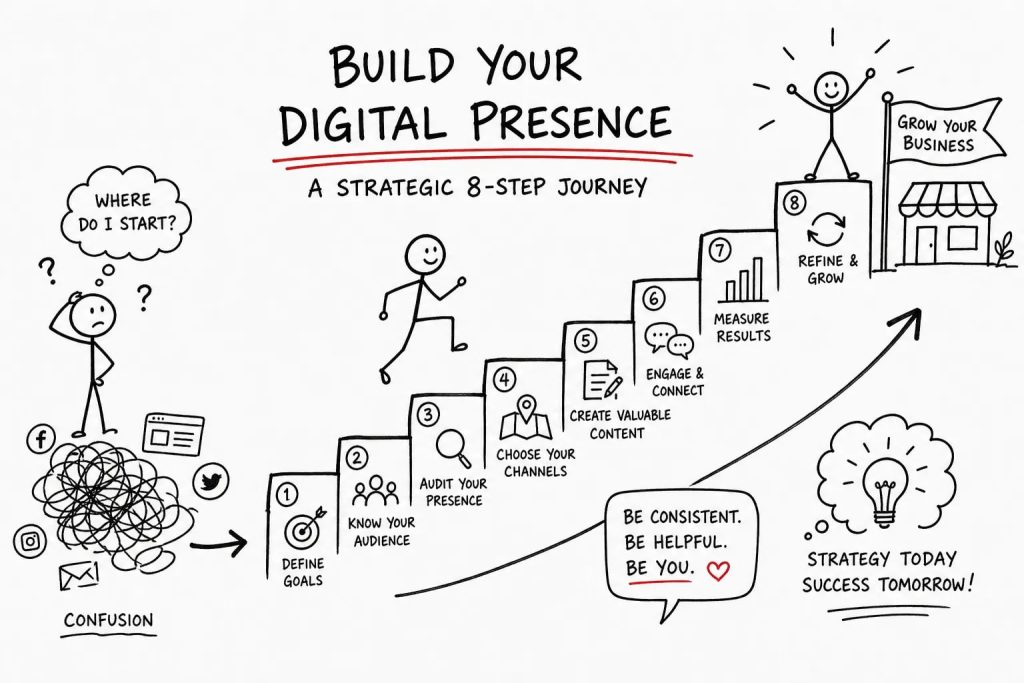
This article walks you through 8 actionable steps to build a resilient digital presence plan. If you want to explore any of these areas in more depth, Working With Walter covers email marketing, lead generation, and local visibility strategies built specifically for small business owners.
Why relying on Google alone puts your business at risk
Algorithm updates are not rare events. They happen multiple times per year, and each one can redistribute rankings across entire industries. If your only lead source is organic Google traffic, a single update can cut your revenue in half before you even know what changed. Managing your digital footprint is a risk-mitigation approach, not just a growth tactic.
A resilient online brand presence runs on four pillars: your website and social media presence, your claimed listings and directories, and your owned channels like email. The goal is not to be everywhere. The goal is intentional channel selection based on where your specific audience already spends time. These four pillars form the foundation for every step that follows.
Your digital presence strategy: overview and foundations
A digital presence strategy is broader than a digital marketing strategy. Marketing strategy focuses on campaigns, messaging, and conversions. Presence strategy focuses on where you show up, how consistently you show up, and what happens to your visibility when any one channel changes. Getting clear on that distinction shapes how you prioritize the eight steps below.
Steps 1-2: Audit your footprint and define your audience
Step 1: Run a presence audit checklist
Before you build anything new, check what you already have. A practical audit covers four areas: website speed and mobile performance, Google Business Profile completeness, social profile consistency, and whether your email list exists at all. Open each channel, verify that your business information matches across platforms, and note every gap you find.
Google Search Console is the fastest free tool for website performance data. It shows what Google actually indexes, which pages get impressions, and where clicks are coming from. Pair it with Google PageSpeed Insights to flag load speed issues. This baseline takes less than two hours to complete and tells you exactly where to focus first.
Step 2: Define who you’re trying to reach before picking any channel
Audience definition is not optional. If you don’t know whether your customers spend time on LinkedIn, Instagram, or TikTok, you’ll waste weeks posting in the wrong places. List your top three to five best existing customers, identify where they spend time online, and use that as your channel filter.
This single step saves more time than any tool or tactic. It keeps you from building a TikTok presence for a B2B service business or investing in LinkedIn ads for a local pizza shop. Know your audience first, then decide where to show up.
Steps 3-4: Build your digital presence strategy across listings and social
Step 3: Directories and local listings that actually drive discovery
According to BrightLocal’s Local Consumer Review Survey, roughly 7 in 10 new customers discover a business through a directory listing before they ever visit the website. That number alone justifies making directory management a priority. Claim and complete these five first: Google Business Profile, Apple Business Connect, Bing Places, Yelp, and Facebook Business Page.
Consistent business name, address, and phone number across every listing is non-negotiable. Inconsistent details split trust signals and confuse both search engines and customers. After claiming each listing, put a review request process in place. Ask for reviews immediately after a successful transaction. Review volume directly affects local visibility, and the habit takes less than five minutes to build into your workflow.
Step 4: Which social profiles are worth your time in 2026
The channel split breaks cleanly along B2B versus B2C lines. Service-based and B2B businesses get the strongest return from LinkedIn and email. Consumer-facing and visual businesses should prioritize Instagram and potentially TikTok. Neither group needs to be active everywhere.
Claim your handle on every major platform even if you don’t plan to post there immediately. This prevents someone else from taking your business username later. Focus your active content effort on one to two platforms only. Posting consistently on two channels beats posting sporadically on six every time.
Get your business found online with the right support
If you’d rather have someone guide you through the directory listings, social profile setup, and ongoing digital visibility work, Working With Walter offers consulting and education built specifically for small business owners. Whether you want a done-with-you approach or step-by-step resources you can implement yourself, it’s a practical option if you’d rather focus on running your business than auditing your listings every quarter.
Steps 5-6: Build the channels you actually own
Step 5: Why email is your most valuable owned channel
Social platforms change their algorithms. Organic reach shrinks. Platforms disappear. Your email list belongs to you, and no platform update can take it away. For most small businesses, email consistently delivers higher conversion rates than organic social, in practice, it often converts several times better for direct sales and lead generation. Campaign Monitor and HubSpot have both reported conversion rate advantages for email in the range of three to ten times organic social, though results vary by industry and list quality.
Start email capture with a low-friction opt-in on your website. A simple lead magnet, a resource download, or a discount offer works well. Follow that with a short welcome sequence of three to five emails, then maintain a consistent send schedule. You don’t need a complex system to start. Working With Walter covers email marketing for small businesses in depth if you want a step-by-step guide to building this out.
Step 6: Content distribution beyond your own website
Publishing content on your website is step one. Getting that content in front of audiences who aren’t already following you is step two. Content distribution means repurposing blog posts for social, submitting guest posts, being featured in local roundups, and using email to amplify content to your existing list.
The same piece of content can reach five different audiences with minimal extra work when you distribute it intentionally. A blog post becomes a LinkedIn summary, a short email to your list, and a guest contribution to a local business association newsletter. That’s three distribution touchpoints from one original piece. The multiplier effect is real, and it compounds over time.
Steps 7-8: Set KPIs and review on a 90-day cycle
Step 7: The metrics that tell you whether your strategy is working
Vanity metrics like follower counts and raw impressions feel good but don’t tell you whether your digital presence strategy is producing business. Build a lean dashboard around four numbers: organic traffic growth, social engagement rate, website conversion rate, and lead-to-customer rate.
For conversion rate benchmarks: 2-3% is good and 5%+ is strong. Track conversions by channel so you know which source is actually driving results. Organic, paid, email, and social should each have their own conversion data. If you can’t see which channel is producing inquiries, you can’t make smart decisions about where to invest your time.
Step 8: How to run a simple 90-day review without overthinking it
Pull your key metrics at the end of each 90-day period. Identify the one or two channels that produced the most leads or conversions. Cut or pause what produced nothing. Double down on what worked. This is a quarterly habit, not a once-a-year exercise.
A practical launch structure runs like this: month one focuses on the audit and setup, month two on consistent publishing and email capture, and month three on analysis and adjustment. By the end of 90 days, you have real performance data instead of assumptions. That data drives every decision in the next cycle.
Conclusion
A digital presence strategy that depends entirely on Google is a single-point-of-failure plan. The businesses that stay visible in 2026 are building presence across multiple channels they control: directories, social profiles, and email lists that no algorithm can take away overnight.
The 8-step path is straightforward. Audit first, then claim your listings, build your email list, distribute content intentionally, and review your KPIs every 90 days. You don’t need to do all of this at once. Pick one step and start there this week. Momentum matters more than perfection.
For deeper guides on email marketing, lead generation, and local visibility, visit Working With Walter. The site exists specifically for small business owners who need practical, no-fluff digital marketing guidance without the agency price tag.
Frequently asked questions
How long does it take to build a solid digital presence strategy?
Plan for 90 days to see meaningful early data. Month one focuses on setup and audit. Month two focuses on consistent publishing and email capture. Month three is when you analyze and adjust based on real performance data. You won’t have everything figured out in week one, and that’s expected.
Do I need to be on every social media platform?
No. Pick one to two platforms where your target audience spends time and commit to showing up there consistently. The key distinction: claim your username everywhere to protect your brand, but reserve your active content energy for no more than two platforms. Spreading effort across six channels almost always produces weaker results than going deep on two.
What’s the most important metric to track first?
Start with your website conversion rate and lead-to-customer rate. These tell you whether your strategy is producing business, not just traffic. A site that gets 500 visits per month and converts at 5% outperforms a site that gets 5,000 visits and converts at 0.2%.
Which directories should small businesses claim first?
Start with Google Business Profile, Apple Business Connect, Bing Places, Yelp, and Facebook Business Page. These five cover the platforms with the highest local discovery volume. After that, add industry-specific directories relevant to your business type.
Is email marketing really better than social media for small businesses?
For direct revenue and lead conversion, yes, and the gap is significant in practice. Social media is valuable for awareness and audience building, but email is where conversion happens for most small businesses. Build both, but prioritize email capture from day one so you’re growing an audience you actually own.